

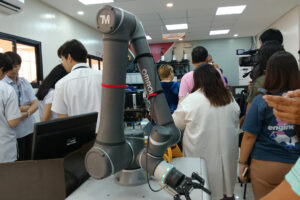
The Department of Science and Technology (DOST) on Monday unveiled Central Luzon’s first Internet of Things (IoT) laboratory, which aims to help students and the academe develop IoT solutions that could help address the region’s pressing challenges.
The facility, called the Internet of Things Research and Innovation Laboratory for Smart Cities (IoTRILS), is located at the main campus of Bulacan State University (BulSU) in Malolos City.
Its total project cost is nearly P5 million, funded by the DOST-Philippine Council for Industry, Energy and Emerging Technology Research and Development (DOST-PCIEERD) and implemented by BulSU.
“(The facility) will help our youth build the skills and knowledge to develop their capabilities,” Enrico C. Paringit, executive director of DOST-PCIEERD, told reporters during the launch event in Filipino.
“This is in line with our so-called Industry 4.0 vision, where our industries, communities, and even households can use IoT to become more productive, safe, and efficient,” he added.
Mr. Paringit told BusinessWorld that IoTRILS aims to prepare students in the region for the demands of global and local industries that are increasingly adopting IoT. The facility could also inspire them to become technology-based entrepreneurs, he said.
Members of the press had a first look at IoTRILS, which houses equipment such as 3D printers, IoT processors, pick-and-place machines, and computer-controlled machines purchased under DOST’s Institution Development Program (IDP).
Paul Ryan A. Santiago, project leader of DOST-funded projects at BulSU, told BusinessWorld that the facility is “fault-proof,” allowing researchers to make mistakes without posing dangerous risks.
One of the IoT solutions developed by BulSU students is a solar-powered early flood-warning system designed to help residents of Hagonoy, a municipality that experiences perennial flooding.
“This is very useful, especially during storms or high tide, when water begins to rise—something that is critical in measuring water levels,” Mr. Santiago said on the sidelines of the launch event in Filipino, noting that data from the device could help the local government issue earlier advisories to residents.
The device uses sensors to collect data, which can then be transmitted to the local government’s database through a Long Range (LoRa) connection and the internet, while operating sustainably.
Mr. Santiago said they are currently coordinating with the municipality of Hagonoy to deploy two units.
Through IoTRILS, BulSU also aims to develop other IoT-driven solutions, such as health monitoring systems for hospital quarantine patients, smart agriculture, and other disaster management measures.
The university has also partnered with PacketWorkx, the country’s first Long Range Wider Area Network (LoRaWAN) provider, for research and development.
As of this writing, DOST-PCIEERD has funded at least 60 IDP projects totaling P312 million, with 30 laboratories nationwide, four of which are in Central Luzon. — Edg Adrian A. Eva
