

The baby boom is credited with building American housing today as we know it. And now, amid an affordability crisis that has pushed the age of a typical first-time buyer to an all-time high of 40, the housing market might be shaping the population of babies.
In what’s come to be known as America’s baby bust, the nation’s fertility rate has fallen to an all-time low of 1.6 children per woman in 2024—well below the replacement rate of 2. Across the U.S., the share of residents under age 5 has fallen sharply over the past decade.
While falling birth rates are a national story, the pace of change is anything but uniform. Some metros are seeing their youngest populations thin out far faster than others, even in regions long viewed as magnets for families.
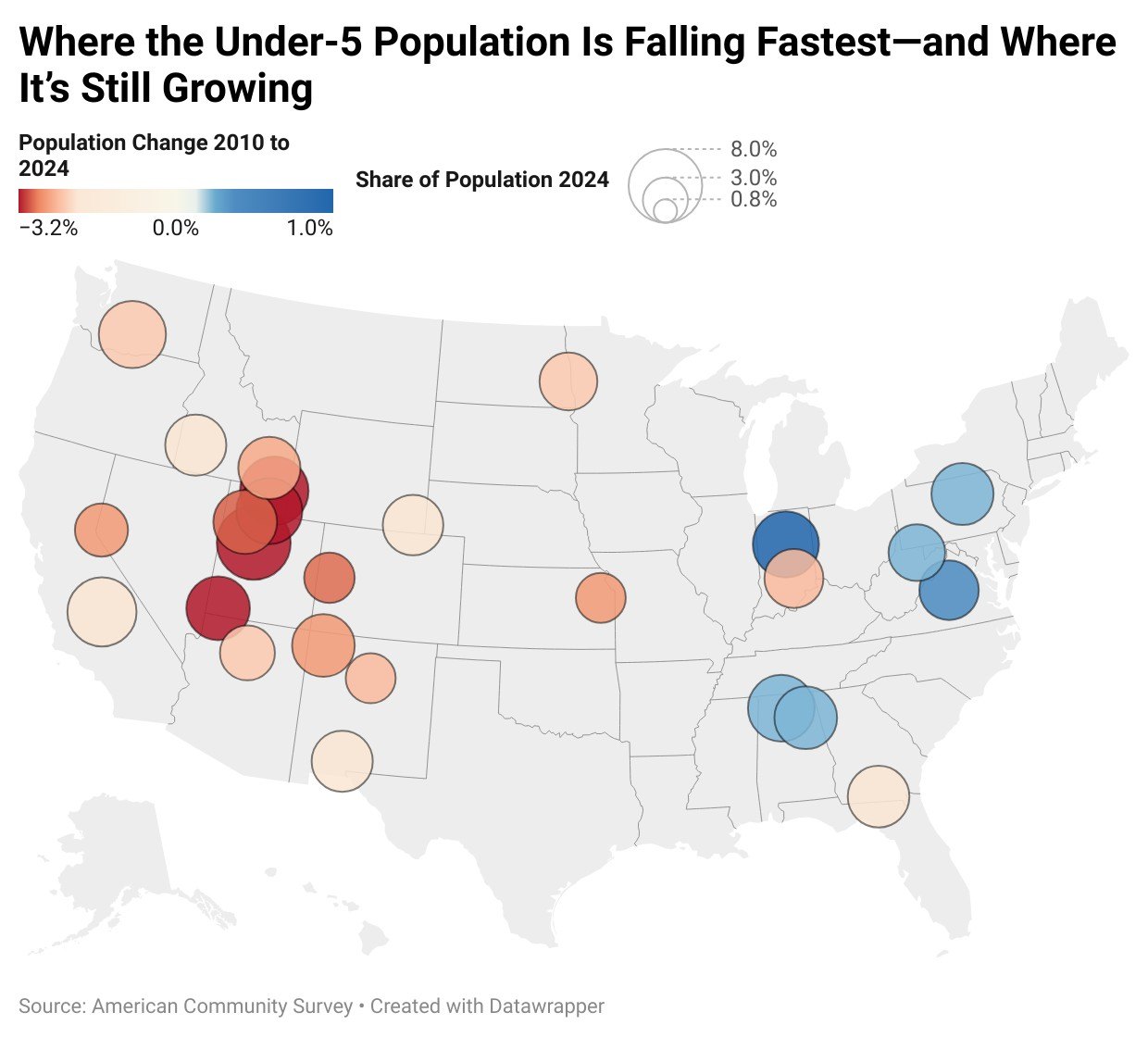
A Realtor.com® analysis of U.S. Census American Community Survey data comparing 2010 to 2024 shows that nearly every metro has lost ground when it comes to its under‑5 population share in a sign that adults are outpacing young children almost everywhere.
Here’s where the under‑5 population is falling the fastest and the few places where it’s still growing.
The metros with the sharpest declines
The metros with the sharpest declines in the under-5 share are clustered in the West, especially in places that have attracted families.
But it’s important to be precise about what this measure captures: This is not a count of babies born or children living in a metro. It’s the under-5 share of the total population, which can fall for at least two different reasons: fewer young kids, or faster growth in other age groups.
In many Western metros, that second dynamic is likely coming into play. Over the past decade, these regions have attracted large inflows of working-age adults and retirees so the denominator grew quickly. Even if the number of young children held steady or dipped only modestly, an influx of adults can still push the under-5 share down.
Then there’s the fact that many of these metros started from a very high baseline in 2010.
Utah is the best example. Metros in the Beehive State had some of the highest under-5 shares in the dataset, which means they had more “room” to fall as fertility trends cooled and in-migration skewed older.
In other words, these results don’t automatically mean these metros are becoming kid-free. Instead, they mean that, relative to everyone else moving in and aging in place, young children are making up a smaller slice of the population.

Utah’s baseline is falling the fastest
Five of the steepest drops are in Utah, in a surprising finding given the state’s reputation for family-friendly living.
Logan, Ogden, Provo, and St. George all saw their share of children under 5 as total population fall 3.2%, followed closely by Salt Lake City, which saw the share drop by 3.1%.
As previously noted, though, in 2010, these metros had some of the highest under-5 shares in the dataset, averaging 9.8% compared to a 6.5% average for the dataset as a whole.
A shift toward later childbearing, smaller families, and faster growth among adults can pull that share down quickly—even if the absolute number of young children doesn’t collapse. At the same time, Utah’s growth has increasingly included working-age transplants and older movers, which mechanically lowers the under-5 share by expanding the denominator.
Why Western growth doesn’t always mean more kids
Outside of Utah, the steepest drops in the under-5 population share are showing up in smaller Western metros—places like Grand Junction, CO, and Carson City, NV.
In Grand Junction, the under-5 share dropped from 6.6% in 2010 to just 3.6% in 2024—among the lowest in the dataset. Carson City saw a similar slide, from 6.6% to 4%.
Like the Utah metros, these cities have become landing spots for retirees and lifestyle-motivated movers—people drawn to mountain views, lower housing costs, or tax advantages. That kind of growth can dilute the share of young children even if birth rates hold steady.
A similar rebalancing is visible in places like Farmington, NM (-2.6%) and Pocatello, ID (-2.5%)—both metros where job cycles and migration can be volatile. In smaller cities like these, a few shifts in major employers or changes in who moves in and out can tilt the age mix quickly.
The rare metros where the under-5 share is growing
In a dataset dominated by declines, just a few metros moved in the opposite direction and posted an increase in the share of residents under-5 between 2010 and 2024.
The standout is Kokomo, IN, where the under-5 share grew from 5.4% to 6.4%—a full 1% gain. A few others posted smaller gains, including Charlottesville, VA (+0.4%), and Decatur and Gadsden, AL (+0.2% each).
The fact that these metros are such stark outliers may make them all the more interesting and important to watch, as they could offer the earliest clues about what’s working when it comes to attracting and retaining young families in an era of falling fertility and rising costs.
Kokomo may offer the clearest case study.
Far from a booming Sun Belt city, this small industrial metro sits in Indiana’s Rust Belt and was once hit hard by the Great Recession.
But over the past decade, the city invested heavily in livability: new apartments, renovated homes, expanded parks and trails, walkable streets, and the return of public transit via a free, five-route bus system, according to City Journal. The goal was simple: Reverse the decline and make Kokomo a place where people want to stay.
Those changes matter for one simple reason: They help families stay put. Many metros lose young households not because of lack of demand, but because housing doesn’t fit the next stage of life. New York City is the clear example here: Between 2020 and 2023, the Big Apple lost 92,000 children under 5 (17% of that population), at a time the median market rate for an apartment had soared by 30%.
If those soaring costs were the poison, Kokomo’s investment in walkable neighborhoods and affordable homes is the clear antidote. It is the rare city that tried to build with families in mind and its growing population of children under the age of 5 seems to be an early signal of success.
It’s exactly the kind of turnaround Pawnee City, NE, is hoping for.
Through its Vision 2030 plan, Pawnee City is offering up to $50,000 in down payment assistance to those who buy newly built homes on revitalized city lots. It’s a flashy pitch and powerful pitch: affordable housing, right-sized for modern families, with a firm welcome mat out front.
Like Kokomo, Pawnee City understands that the future of cities hinges on whether they can make room for families—not just retirees or remote workers, but households looking for community, stability, and a path to ownership. And while the scale may be different, the playbook is remarkably similar: Build the housing, improve quality of life, and let the numbers follow.
These outliers may not change the national trend overnight. But they’re early signals that, with the right ingredients, it’s still possible to grow the youngest generation, even in places most had counted out.
