

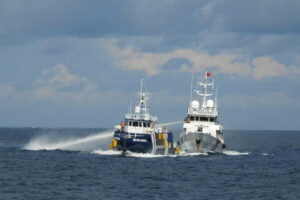
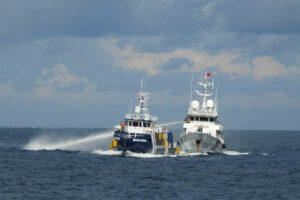
THE US on Monday voiced support for the Philippines amid rising tensions with China in the South China Sea, condemning what it called Beijing’s increasingly coercive behavior after Chinese coast guard vessels injured Filipino fishermen in a Dec. 12 confrontation.
In a statement, the US Department of State said China’s actions in the strategic waterway were dangerous and destabilizing, citing an incident last week in which Chinese ships fired high-pressure water cannons at Filipino fishing boats.
“These aggressive actions endangered Filipinos fishing for their livelihoods,” the State Department said. “We stand with our Philippine allies as they confront China’s provocative actions and increasingly dangerous tactics against its neighbors.”
The Philippine Coast Guard on Saturday said three Filipino fishermen were wounded and two fishing vessels sustained significant damage after ships from the China Coast Guard used water cannons near Sabina Shoal, a contested maritime feature in the South China Sea.
The shoal is among several areas claimed by both Manila and Beijing where confrontations at sea have become increasingly frequent.
Philippine officials have described China’s activities as coercive and escalatory, while Beijing maintains that its patrols and enforcement measures are legitimate actions to defend its sovereignty.
China’s Foreign Ministry spokesman Guo Jiakun said Philippine vessels targeted by water cannons had deliberately anchored at Sabina Shoal despite repeated warnings from the China Coast Guard.
“The Philippines needs to immediately stop its infringement, provocations and vilification, stop its endless self-directed stunts at sea, and refrain from challenging China’s firm resolve to safeguard our sovereignty and rights and interests,” he told a news briefing, based on a transcript published on the ministry’s website.
Mr. Guo added that US “has no right to interfere in the maritime issues” in the South China Sea and should stop supporting Manila’s efforts to stake its claim in the contested waters.
China asserts rights over nearly the entire South China Sea through its so-called nine-dash line, a claim that overlaps with those of the Philippines, Vietnam, Malaysia, Indonesia and Brunei. A United Nations-backed arbitration ruling in 2016 voided China’s sweeping claims, though Beijing has refused to recognize the decision.
Tensions have flared repeatedly over the past year near key maritime features, including areas seen as critical to Philippine resupply missions to marines stationed aboard the BRP Sierra Madre, a grounded naval ship serving as an outpost at Second Thomas Shoal.
Sabina Shoal lies about 150 kilometers (km) west of the Philippine province of Palawan.
The latest incident underscores the growing risks faced not only by military vessels but also by civilians operating in the disputed waters, as fishermen and civilian missions increasingly find themselves on the front lines of geopolitical rivalry.
Also on Monday, a coalition of Philippine civil society groups pledged to step up civilian activity in the South China Sea in response to what it said was mounting harassment by Chinese vessels.
The Atin Ito (This Is Ours) coalition, which has organized annual civilian sails to assert Philippine presence, said it plans to launch more missions next year.
“In 2026, we will mount more civilian missions to further civilianize these waters,” Rafaela David, co-convenor of the coalition, said in a statement. “The answer to harassment and violence is solidarity and active citizenship.”
The group’s volunteers have staged several civilian voyages in the past two years and earlier this year held a concert at sea near Thitu Island, known locally as Pag-asa.
Thitu is the second-biggest island in the disputed Spratly Islands and hosts a small Filipino civilian community that has lived there since the early 1970s. The island lies roughly 500 km west of Palawan.
Competing claims in the South China Sea have fueled frequent encounters between Philippine and Chinese vessels, with both sides seeking to reinforce their claims through patrols, infrastructure development and diplomatic pressure.
Last year, a civilian flotilla organized by Atin Ito abandoned plans to sail close to Chinese-controlled Scarborough Shoal to avoid a potential clash with dozens of Chinese ships guarding the area.
The US has repeatedly reaffirmed that its Mutual Defense Treaty with the Philippines applies to armed attacks on Philippine forces, vessels and aircraft in the South China Sea, a stance that Manila sees as a crucial deterrent amid China’s expanding presence in the region.
‘DEEPLY REGRETTABLE’
Meanwhile, the National Maritime Council (NMC) expressed alarm over the recent “harassment and endangerment” of the Filipino artisanal fishers at Sabina Shoal.
Aside from the water-cannon attack, China Coast Guard vessels also deliberately cut the Filipino fishing boats’ anchor lines, it said in a separate statement.
“These acts placed the lives of these Filipino artisanal fishers at greater risk, adding further danger to the already difficult sea conditions,” the council said. “It is deeply regrettable that three Filipino fishers suffered physical injuries, and two fishing boats were damaged.”
The Philippine government promptly responded by deploying Philippine Coast Guard (PCG) vessels BRP Malapascua and BRP Cape Engaño to help and protect the fishermen.
“As these PCG vessels carried out their humanitarian and safety mission, they were repeatedly subjected to dangerous maneuvers and close-range approaches by multiple China Coast Guard ships, including a particularly hazardous nighttime incident,” it pointed out.
The China Coast Guard’s public statement citing the use of “necessary control measures” is “deeply troubling,” the council said.
“Any measure that involves water cannons, dangerous maneuvers and actions that cause injury and damage to small, wooden civilian fishing boats cannot be justified, particularly when undertaken against subsistence fishers peacefully fishing in the Philippines’ exclusive economic zone,” it added.
The Philippines would come up with an appropriate diplomatic response and register its “strong objection” to these actions, the maritime council said.
Palace Press Officer Clarissa A. Castro said the Philippine government would deliver its protest to the Chinese Embassy in Manila on Monday. “We are giving a demarche to the Chinese Embassy today,” she told a news briefing. — K.C.L. Basilio
