

Key takeaways
- Economists are confident that the housing market is not going to crash. Instead, they say it’s undergoing a correction that will likely take many years.
- Home prices recently fell for the first time in three years as demand continued to weaken – a trend that should marginally improve in 2027.
- Lending standards are much stricter than they were before the Great Recession, reducing the risk of a credit-driven collapse.
- Home buyers and sellers are feeling the strain of a very unaffordable housing market and volatile economy.
Today, the housing market feels stuck. Prices are high, very few homes are selling, and concessions are common. Most buyers are priced out by historically low affordability, while sellers are becoming hesitant to list, instead choosing to hold onto their low-rate mortgages or waiting for conditions to improve. Consumers are concerned about the state of the economy and how dramatically the market has flipped from hot to cold since the pandemic
However, most economists are confident that the housing market is actually undergoing a long-term correction, not spiraling out of control. The last real estate crash in the U.S. happened during the Great Recession nearly two decades ago, when a housing bubble fueled by risky lending triggered a collapse. Today’s market looks fundamentally different, albeit far less affordable.
So, if you’re a buyer or seller stuck on the sidelines wondering if the housing market is going to crash, this article is for you. Let’s break down what a housing market crash looks like, why economists are confident we don’t need to worry, and why buyers and sellers are on edge.
From Redfin’s Chief Economist
“We’re in the middle of an uneven and long-term housing market correction, not a housing market crash. After the pandemic-era frenzy sent prices soaring and inventory to historic lows, the market needed a reset. What we’re seeing now is not a sudden collapse but a yearslong comedown that varies by region: slower sales, flatter or falling prices, and buyers gaining leverage. A volatile economy and inflation are throwing a wrench in things, but the market is just largely unaffordable, not crashing.” – Daryl Fairweather, Redfin Chief Economist
>> Watch: Home Prices Can’t Crash. Here’s the Math.
What is a housing market crash?
A housing market crash is a sudden, sharp, widespread drop in home values. Crashes usually stem from broader economic or financial shocks, like a recession, a surge in speculative lending, high inflation, or rising unemployment. Those pressures can quickly spill into housing, triggering oversupply or a sharp drop in demand.
During a crash, several things typically happen at the same time:
- Home prices fall quickly across the nation
- Buyer demand drops, often due to job losses, high interest rates, or delinquency
- Home sales slow sharply
- Foreclosures and mortgage defaults increase as homeowners struggle to keep up with payments
Housing crashes rarely happen in isolation. They’re usually tied to broader economic shifts, such as recessions, financial crises, or risky lending practices. The last true real estate crash in the U.S. happened during the 2007 – 2009 Great Recession, which was linked to a burst housing bubble and mortgage lending crisis.
Why the housing market is unlikely to crash
While the housing market today is slow, expensive, and impacted by widespread political and economic uncertainty, experts are confident that the housing market is not going to crash. Instead, they say it’s experiencing a prolonged “reset” from the pandemic, when house prices and inflation skyrocketed.
“The idea that there’s a crash just around the corner is a narrative that forms whenever the economy goes through a seismic shift,” said Chen Zhao, Head of Economics at Redfin. “There has also been a lot of news surrounding a recent jump in foreclosures and surge in bond market yields, which has stoked fears. But these headlines are overblown. Today, most signs are pointing to a long-term reset: Prices are leveling out or dipping slightly, wages are climbing, distressed sales remain low, and affordability is improving. But the economy is in tumult and housing is still incredibly expensive, so it’s natural for people to worry.”
Let’s dive a bit deeper into why economists believe housing isn’t heading toward a crash.
Home prices are slowly ticking down
Before a crash, you might see home prices spike sharply and then suddenly plunge as the housing bubble bursts. That’s not what we’re seeing today. Price growth is slowing across much of the country – and prices even dropped for the first time in three years in October. Most analysts expect these trends to continue into 2027 and beyond as the market slowly adjusts to a new normal and affordability improves.
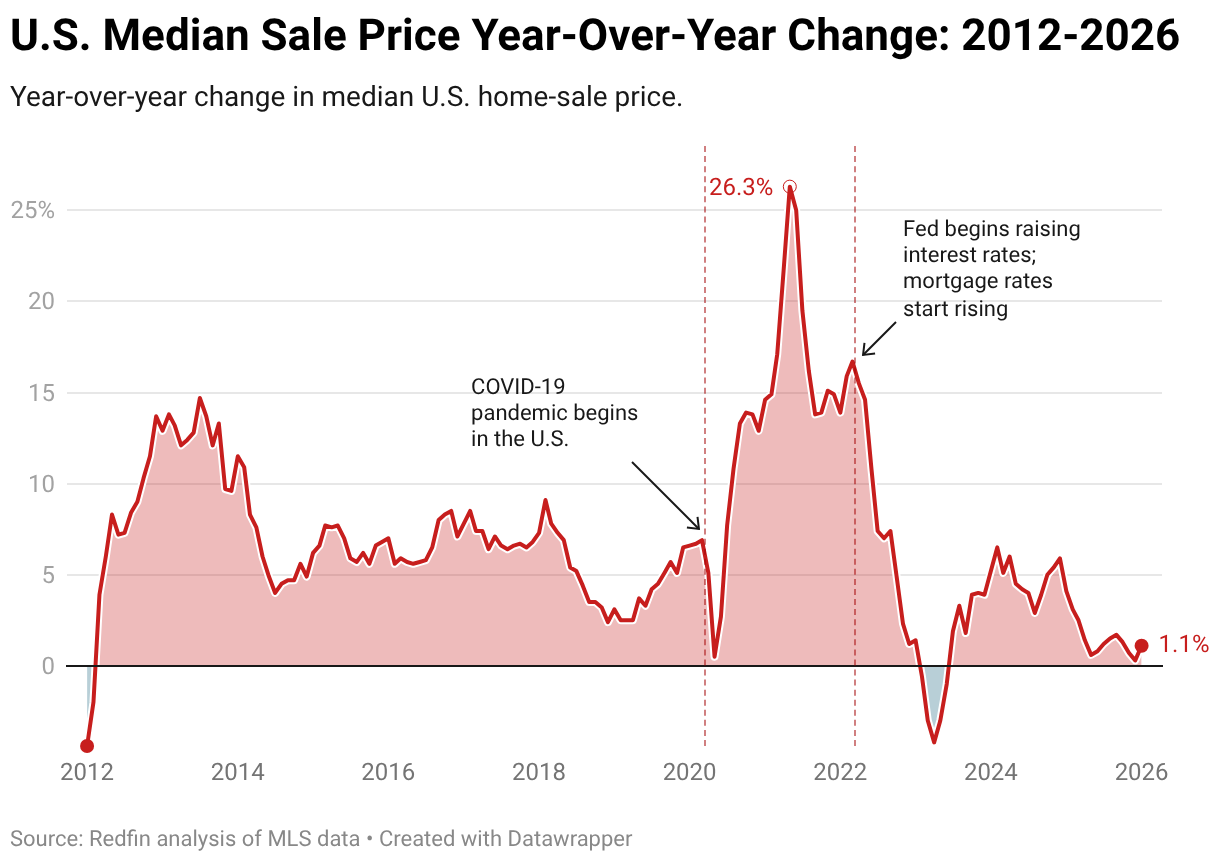
Of course, there are regional exceptions. Parts of the Northeast and Bay Area with limited inventory are still seeing very fast growth. Meanwhile, prices are falling in a few overheated markets in the Sun Belt, notably Austin, which recently flipped from the hottest to the coldest market in the nation.
Mortgage rates are settling into a new normal
A sudden increase or decrease in mortgage rates can trigger major shifts in the housing market, like a surge in demand or sharp drop in listings. That’s generally not what we’re seeing today. Even though rates have jumped significantly since March due to inflation and the conflict in the Middle East, listings are still climbing and demand is muted. Rates will likely remain elevated for the foreseeable future.
“It’s unclear exactly what would happen if rates dropped dramatically, but we probably wouldn’t see a surge in prices,” continued Zhao. “One reason is because a drop in rates would likely mean the economy is in a recession, which would limit buyers’ spending power. Another is because more supply might hit the market as sellers become “unlocked” from their pandemic-era rates. This is already beginning to happen: The share of homeowners with mortgage rates above 6% now outnumbers those with rates below 3%, helping inventory climb.”
The labor market is relatively strong
Unemployment and job growth have an outsized impact on the housing market. Mass layoffs and rising unemployment are two of the main triggers of housing crashes, because they can lead to missed mortgage payments, forced sales, and foreclosures. When a lot of people quickly lose their income, housing demand often drops and supply spikes as financially strained homeowners are forced to sell.
That’s not what we’re seeing today.
“The job market has been holding up relatively well, which is why we aren’t seeing a surge in foreclosures or delinquencies,” added Zhao. “There are some worrying signals that employment could shift in the future – especially surrounding the heavy investment into AI and decline in workforce participation – and official job reports have been more volatile lately. But a generally stable employment trend is a key reason economists don’t expect a wave of foreclosures or distressed sales. Time will tell how the labor market responds to a rapidly changing economy, though.”
There are stricter lending requirements
Regulations put in place after the 2007-2009 financial crisis tightened mortgage lending standards to reduce risky loans and prevent another broad mortgage-credit collapse. These rules – like requiring banks to hold more money in reserve to cover potential lending losses – make it less likely that credit alone will ignite another crash.
“We are unlikely to see another credit-induced economic collapse given the strict lending standards set in 2010 and strengthened in 2024,” noted Fairweather. “Stronger oversight and more transparent underwriting makes the housing market far more resilient than it was two decades ago. The Trump administration recently proposed easing many of the Recession-era guardrails to get banks back into the mortgage business, which would likely affect market stability, but the proposal is now mired in lawsuits.”
There have been examples of banks lowering underwriting standards on FHA loans to gather more, riskier, business. This practice has led to a rise in defaults, but has been isolated.
Why buyers and sellers are worried about a housing market crash
Even though a real estate crash is unlikely, everyday Americans are still dealing with the effects of a volatile and very unaffordable housing market – especially younger generations.
To better understand the difficulties, let’s break down some key data behind today’s market.
The pandemic housing boom and bust
The pandemic threw the housing market off kilter and gave buyers and sellers a major case of whiplash, which prompted some experts to fear that a crash was possible.
Real estate activity grinded to a halt in early 2020 before skyrocketing to record heights in 2021 – 2022, as remote work and ultra-low mortgage rates unleashed a buying frenzy centered in the Sun Belt. But when mortgage rates spiked and affordability collapsed in 2022 – 2023 due to historic inflation, demand fell sharply.
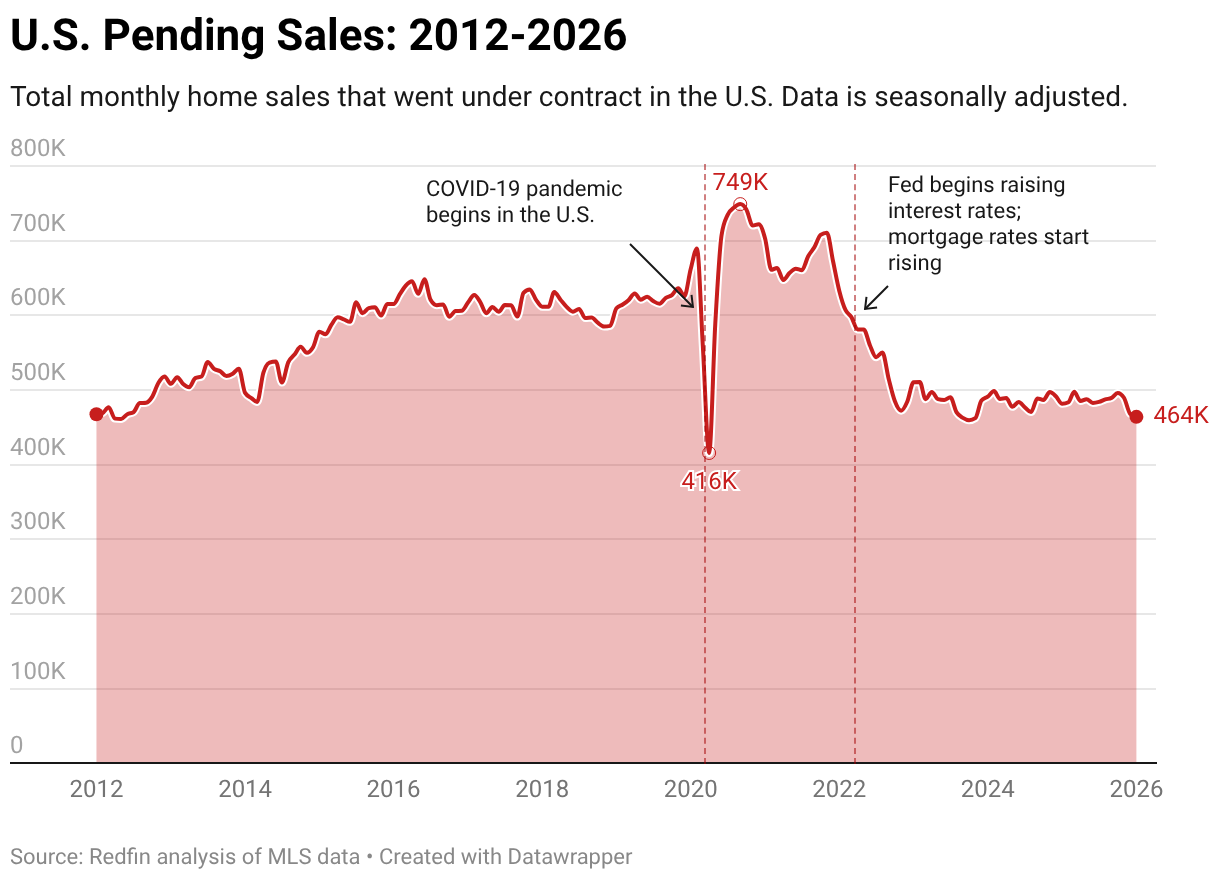
Today, the housing market is in the early stages of recovery, with buyers still priced out but sellers slowly coming off the sidelines. Because of the imbalance between buyers and sellers, price cuts are fairly common nationwide and regular in the Sun Belt where most people moved during the pandemic – especially Austin, Nashville, and San Antonio.
There are some outlier cities clustered in the Northeast where homes are selling like hot cakes and prices are rising, like Newark and Buffalo. But that’s largely because they are more affordable and have a smaller pool of homes for buyers to choose from. San Francisco is also very hot as buyers flush with AI wealth look to settle down.
A potential “housing bubble”
Home prices have hit new records nearly every month for the last two years, raising concerns about whether real estate is in “bubble” territory – when prices are unsustainably inflated. A major inventory shortage has been largely to blame, though it is slowly improving.
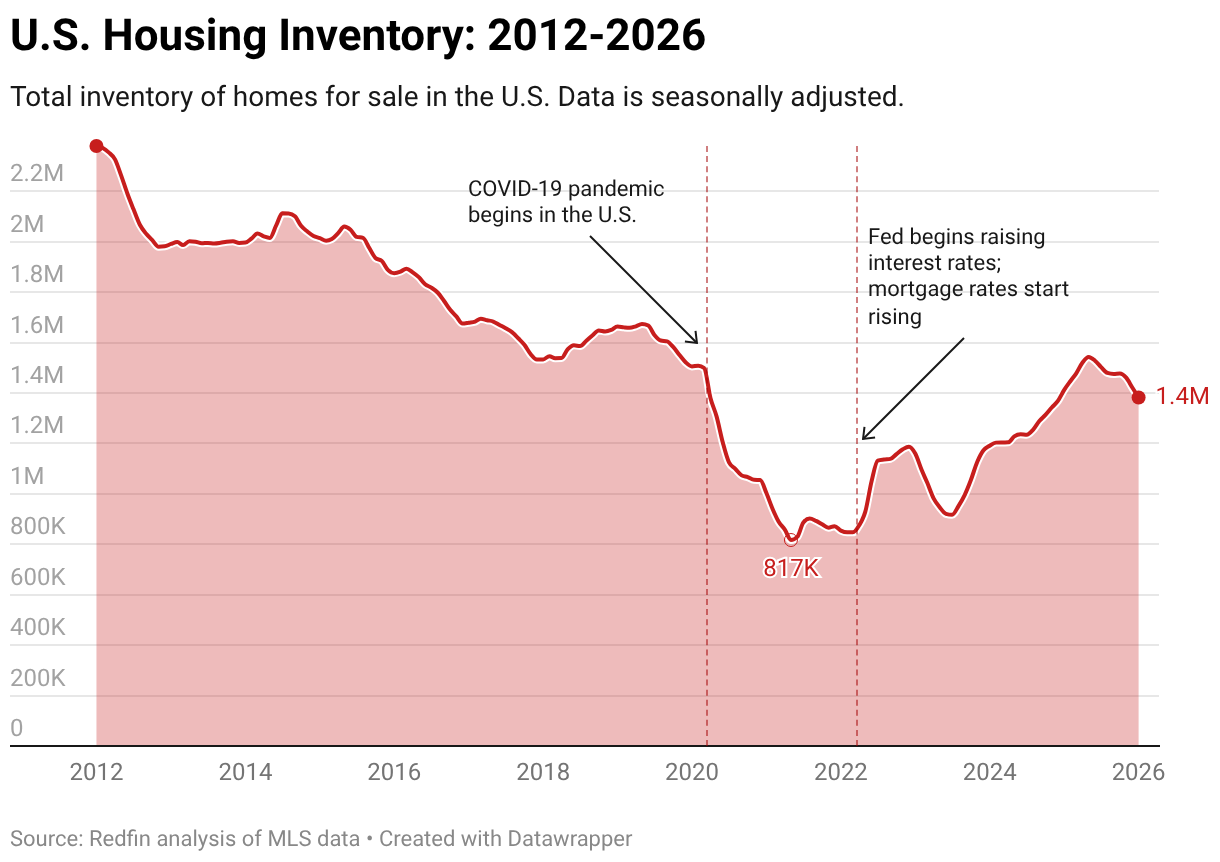
A few experts have noted that the larger problem may be a shortage of affordable homes. Those who can afford a home today are often still buying, but most consumers are simply priced out.
Record-low affordability and economic unease
Maybe most importantly, Americans are living through a prolonged period of uncertainty and record-low affordability. Elevated mortgage rates, stubbornly high home prices, and broad economic anxiety have made housing feel out of reach for many people.
According to Redfin data, the typical American spends about 34% of their income on housing, while home prices have risen roughly 20% in the last five years.
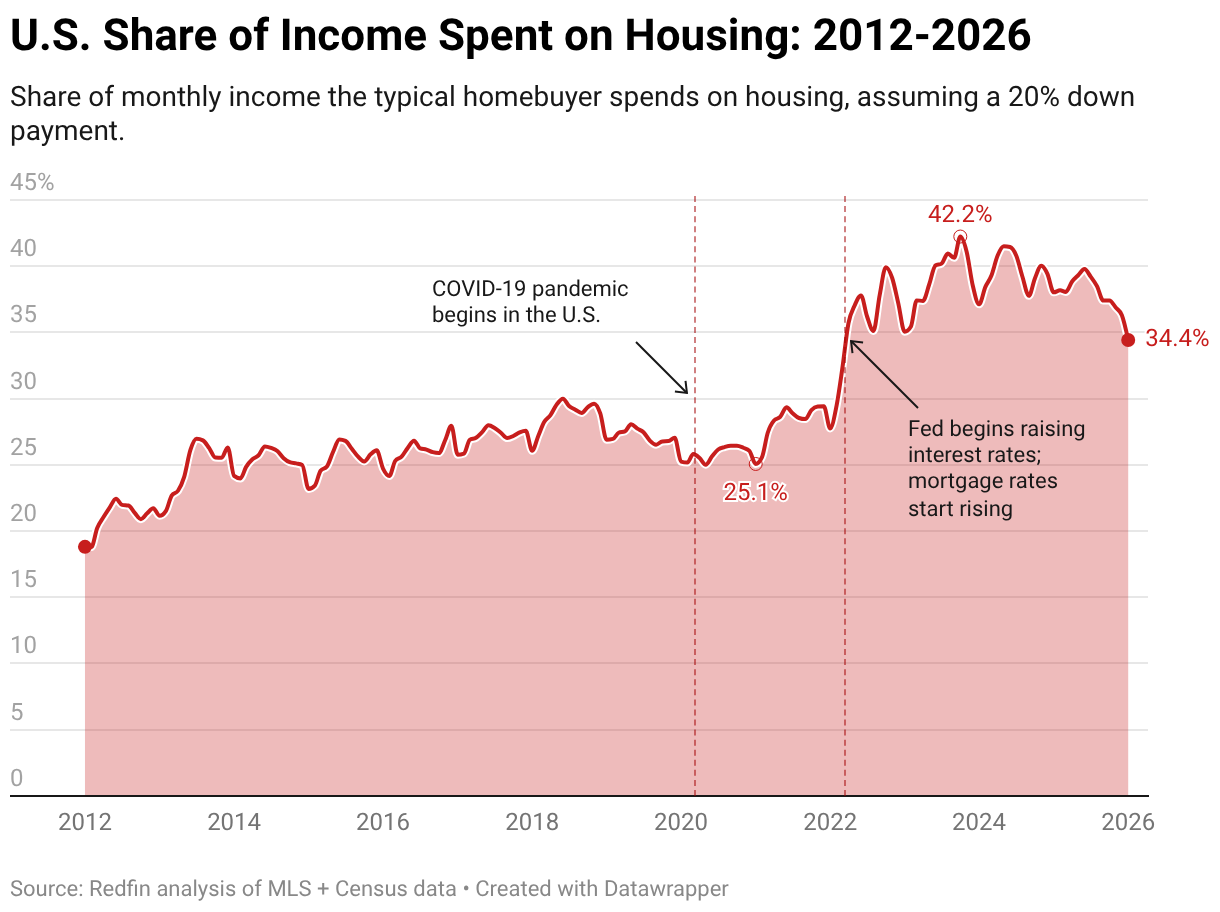
But affordability is improving as price growth slows and wages rise. It’s possible that prices will return to “normal” by 2031, meaning a median earner will be able to afford a median-priced house spending 30% of their income on monthly payments. Costs ebb and flow with the economy, though, so that timeline is theoretical.
Even so, the mix of financial pressure and uncertainty is reshaping how buyers and sellers behave and view the dream of homeownership. This is one of the biggest reasons the market feels so unstable, even without the signs of a bubble bursting.
Final thoughts: The housing market is undergoing a correction, but it is not crashing
The housing market is most likely not heading toward a crash. Instead, it’s undergoing a long-term correction. A housing market correction is a slower, often uneven normalization in prices, inventory, demand, and other economic factors.
Today, prices are flat or falling in many overheated markets, sales are dropping, inventory is muted, and buyers have the most negotiating power they’ve ever had. There isn’t the wave of foreclosures, plummeting home values, or systemic financial stress that defines a crash. For buyers who can afford to buy now, today’s market offers more opportunities and better deals than the highly competitive conditions of the early 2020s.
It’s hard to say what the future will look like. But if current trends continue, the housing market will become more accessible for more people in the future.
