

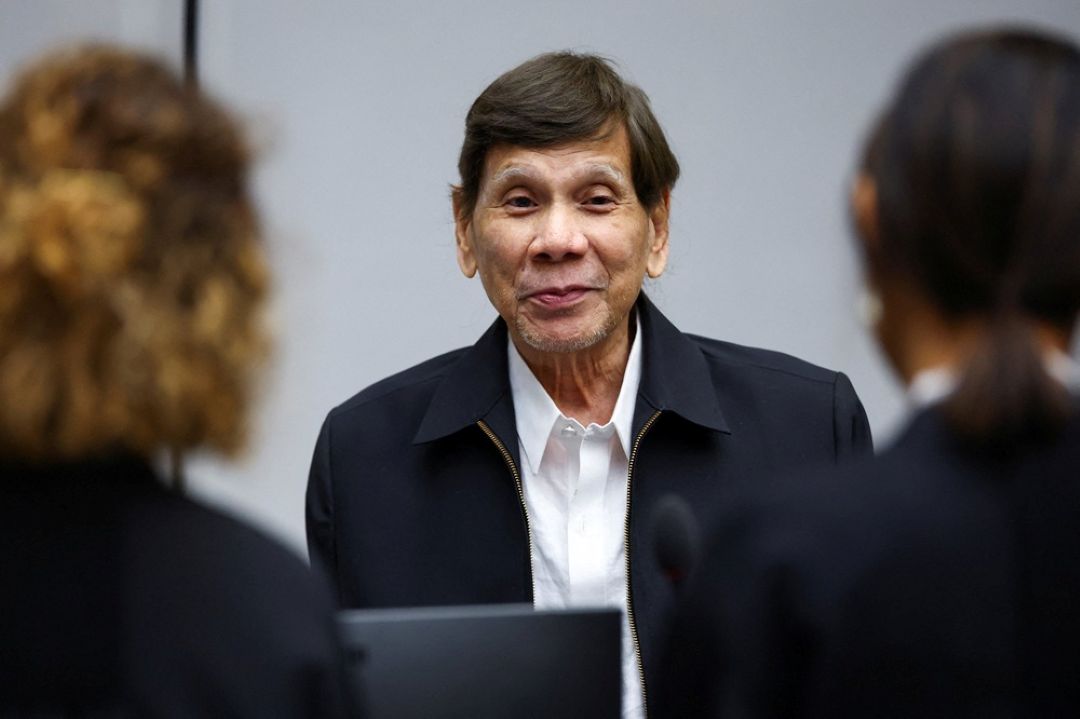

By Deanne Reese D. Imperial and Erika Mae P. Sinaking, Reporter
FORMER President Rodrigo R. Duterte’s defense team said the case linked to his anti-drug campaign does not meet the legal threshold for crimes against humanity, arguing prosecutors failed to establish widespread or systematic attacks.
In a 77-page pre-trial filing dated Nov. 25, Mr. Duterte’s defense team, led by Peter Haynes, said the prosecution faces “significant legal obstacles” even if it succeeds in proving each of the 85 charged murders and two attempted murders beyond reasonable doubt.
“The case the Prosecution has framed against Mr. Duterte is not a crimes against humanity case because the evidence — even taken at its highest — cannot establish contextual elements,” the filing read.
Citing Article 7 of the Rome Statute, Mr. Haynes said the prosecution needed to establish there was a widespread or systematic attack directed to any civilian population and a state or organizational policy to murder.
“This is not a crimes against humanity case and, as such, does not belong before this Court.”
Mr. Duterte, 81, faces three counts of crimes against humanity, comprising of murder and attempted murder, linked to the anti-illegal drug campaign during his time as president and as mayor of Davao City.
Mr. Duterte, who has been in the custody of the International Criminal Court (ICC) since he was surrendered in March 2025, is scheduled to go on trial on Nov. 30.
The defense argued that the crimes being tied to the former president are “sporadic in nature,” citing that the acts thrown against Mr. Duterte did not have a more specific scale or timeline and occurred in different contexts.
“The figures the Prosecution does put forward derive from different sources and, confusingly, describe different categories of deaths,” the counsel said.
The validity of the alleged objects of crimes in this case was also challenged by Mr. Duterte’s team, arguing that the “alleged criminals” could not necessarily be categorized into one population just because they share the same race, ethnicity, or other “similar distinguishing feature.”
“However, the important factor is that the attack is directed against ‘a collective, as opposed to individual civilians,’” Mr. Haynes said. “As such, the civilian population ‘must form a sufficiently stable and identifiable group of individuals, either geographically or as a result of certain common features.’”
The counsel further claimed that the prosecution did not meet the minimum quantitative threshold for the case.
The Trial Chamber III will review 49 incidents involving the death of 79 people and attempted killing of two others.
Mr. Haynes also debunked the existence of the infamous vigilante group Davao Death Squad — referring to it as mere “media folklore” that has different meanings attached (especially in Davao) — invalidating the prosecution’s assertion that some killings were linked to it.
The counsel consequently negated the prosecution’s strike on Mr. Duterte’s “neutralization” remarks during his presidential speeches, arguing that his rhetoric should be assessed based on cultural context rather than literal meaning.
“What needs to be determined is whether Mr. Duterte’s rhetoric, confronting as it is to Western ears, meant the same to its intended audience,” the counsel said.
Human rights lawyer and National Union of Peoples’ Lawyer president, Ephraim B. Cortez, however, said that Article 7 does not require both conditions to establish crimes against humanity.
“[The article] does not require both conditions to be present; either is sufficient for the ICC to exercise jurisdiction. The Pre-Trial Chamber has confirmed the charges against Duterte, and the case is proceeding to trial on the merits,” Mr. Cortez told BusinessWorld on Viber chat.
Mr. Cortez added the prosecution’s argument stands on the basis that the Duterte’s administration executed the alleged organized killings “were carried out through a common plan” originating in his mayoral term in Davao City.
PALACE DEFENDS DUTERTE TRANSFER
Meanwhile, the Philippine government on Thursday maintained the legality of Mr. Duterte’s surrender to the ICC, citing a 2009 domestic law that allows the transfer of people accused of crimes against humanity to an international tribunal.
Palace Press Officer Clarissa A. Castro said Republic Act (RA) No. 9851 answers the sovereignty concerns raised by Vice-President Sara Duterte-Carpio, the former president’s daughter.
“If we accept RA 9851 and we were once a member of the ICC, sovereignty is not up for discussion, because we ourselves voluntarily became a member and we made the law RA 9851,” Ms. Castro told a news briefing in Baguio City.
The law, signed on Dec. 11, 2009, allows the surrender of an accused person to an international tribunal for crimes such as genocide and crimes against humanity.
This followed Ms. Duterte’s remarks that the Philippine Supreme Court should not dismiss as moot the petitions challenging her father’s transfer to The Hague, after the top court threw out the cases.
Ms. Castro said the court has already ruled on the matter. She said a petition for a writ of habeas corpus is a domestic remedy that cannot be enforced in another country.
“Questioning any decision of the Supreme Court is done through a motion for reconsideration,” Ms. Castro said, a recourse the Duterte camp said it would take, according to its lawyer on Wednesday.
The ICC appeals chamber has maintained that it retains jurisdiction over alleged crimes committed while the Philippines was still a party to the Rome Statute, despite the country’s withdrawal in 2019.
