


Bitcoin has slipped below the $83,000 level as selling pressure continues to dominate global markets, extending a correction that has unfolded alongside broader risk-off conditions. Weakness across equities and commodities has weighed on investor sentiment, and Bitcoin has not been immune to this environment. With volatility elevated and liquidity thinning, market participants are increasingly cautious, and several analysts now point to the possibility of a deeper retracement toward lower demand zones before any meaningful stabilization can occur.
Related Reading
Beyond price action, on-chain data suggests that the Bitcoin network itself is entering a period of unusually low activity. Transaction demand has cooled, and miner fee generation remains muted, signaling limited urgency for blockspace. This “quiet” state reflects a market where speculative interest has faded, and organic usage is subdued, a combination that often emerges during corrective or transitional phases rather than during strong uptrends.
At the same time, the lack of aggressive on-chain selling pressure indicates that the move lower is not being driven by panic but by persistent distribution and reduced participation. This creates an environment where price can drift lower with relatively little resistance.
As Bitcoin searches for its next area of support, the coming sessions will be critical in determining whether current weakness evolves into a deeper correction or forms the foundation for a more durable base once activity and demand begin to recover.
An analysis from Onchain Mind highlights a key metric for assessing the underlying health of the Bitcoin network: the Miner Fees to Block Subsidy Ratio. This indicator measures how much of miners’ revenue comes from transaction fees compared to the fixed block reward, making it a direct proxy for organic demand for blockspace. When users are competing to have transactions included in blocks, fees rise, and this ratio increases. When activity slows, the ratio compresses.

Since July, this metric has remained pinned below 1%, marking a sharp and sustained cooldown in network usage. This stands in stark contrast to the conditions seen last May, when the ratio surged above 15% during periods of heightened on-chain activity and speculative demand. At that time, elevated fees reflected strong competition for blockspace and a network operating near capacity.
The current environment tells a very different story. Persistently low fee contribution suggests that transaction urgency has largely evaporated, with users showing little willingness to pay premium fees for settlement. Historically, such prolonged periods of subdued fee pressure have been associated with bear market phases, when participation declines and on-chain activity contracts.
This does not signal immediate stress for miners, given the dominance of the block subsidy in revenue. However, it does underline a broader slowdown in network engagement, reinforcing the view that Bitcoin is currently operating in a low-demand, defensive phase rather than a growth-driven one.
Related Reading
Bitcoin’s price action continues to reflect a market under sustained pressure. BTC is now trading near the $83,000 area after failing to hold recent consolidation lows. The chart shows a clear sequence of lower highs and lower lows since the November peak. Confirming that the broader structure remains bearish rather than corrective.
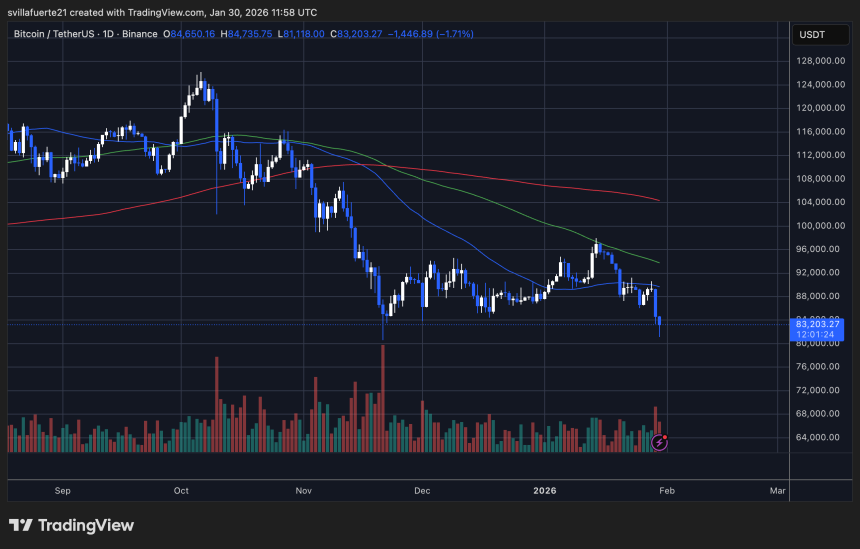
Price is firmly below the 50-day and 100-day moving averages, both of which are sloping downward and acting as dynamic resistance, while the 200-day moving average remains well above current levels, reinforcing the loss of long-term trend support.
Related Reading
The recent breakdown below the $85,000–$84,000 zone is technically significant. This area had previously acted as a short-term base during December and early January. But the failure to defend it suggests that buyers are no longer willing to absorb supply at these levels. Volume spikes accompanying the latest sell-off indicate distribution rather than capitulation, pointing to continued, orderly selling pressure.
The market is transitioning into a price discovery phase toward lower demand zones. If downside momentum persists, the next areas of interest lie near the $80,000 psychological level. Followed by deeper support closer to the low-$70,000 range, where previous consolidation occurred in mid-2024.
Featured image from ChatGPT, chart from TradingView.com
