

In this post you’ll learn:
- Why gross margin is a misleading metric for decision-making
- How to calculate contribution margin and why it matters more
- The real math behind why discounts hurt way more than you think
This is a post in our series on Financial Mastery for eCom Owners, specifically Commandment #2: Master Your Financial Statements.
Two products. Same price. One has 65% gross margin, the other has 50%.
Which one do you push harder?
If you said the 65% margin product, you might be leaving serious money on the table. I’ve watched store owners make this mistake over and over – prioritizing products, killing campaigns, and allocating resources based on a number that doesn’t tell the full story.
Gross margin is one of the most looked-at metrics in eCommerce. It’s also one of the most misleading.
What Gross Margin Actually Tells You
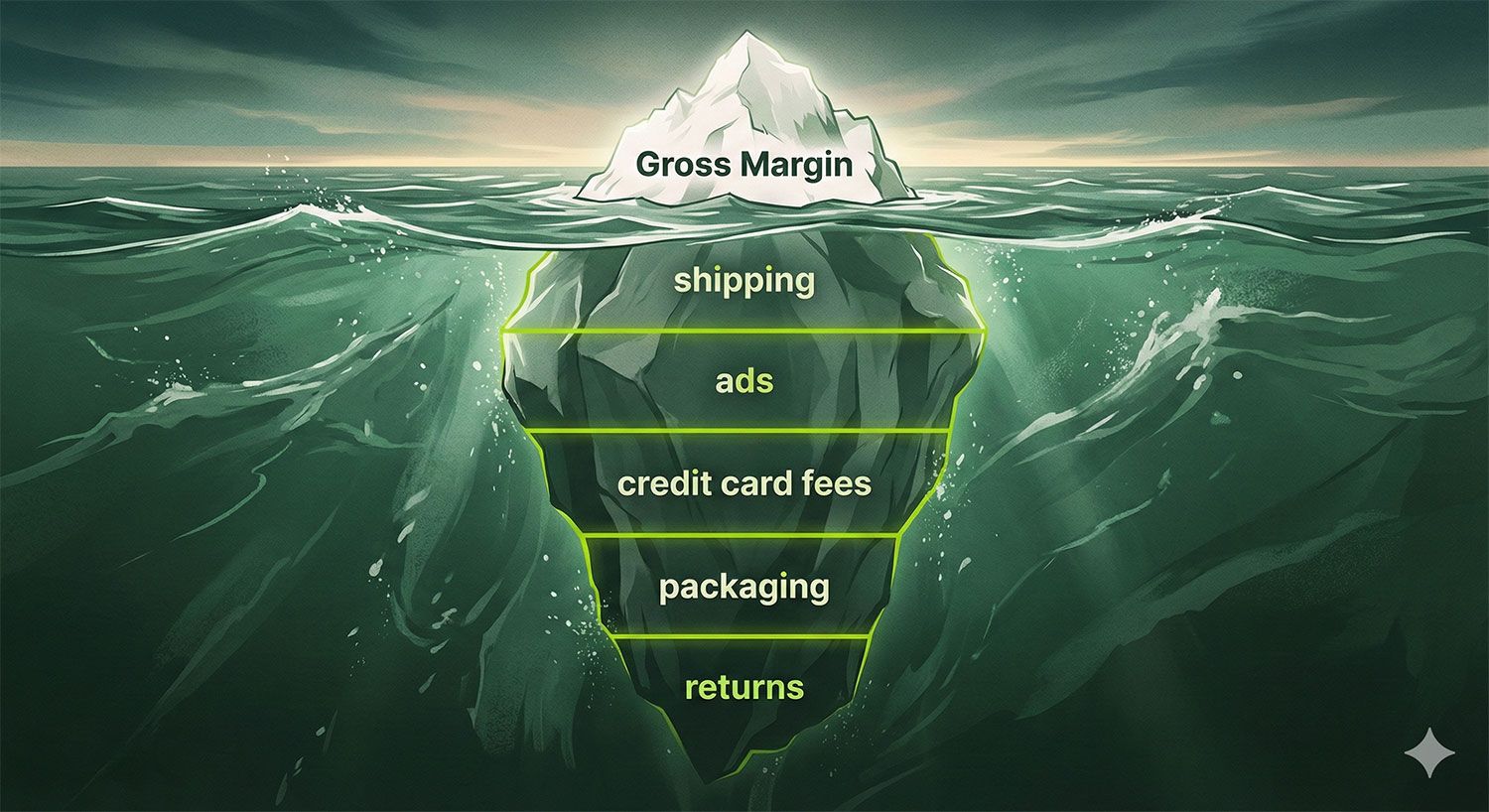
Gross margin tells you what it costs to manufacture your product and get it to your warehouse.
That’s it.
It doesn’t account for customer acquisition costs. It ignores shipping and packaging. It skips over credit card fees, returns, and all the other variable costs of actually selling and delivering that product to a customer.
So when you look at your P&L and see a healthy gross margin, you’re seeing an incomplete picture. Your income statement is giving you one big average across all products and all channels – and that average is hiding the truth about what’s actually making you money.

The Metric That Actually Matters
Contribution margin tells you what’s left after ALL variable costs are paid. It answers the question: “When I sell this product, how much actually goes toward covering my overhead and generating profit?”
This is the number that should drive your decisions.
Let me show you why with a real example.
The Bells of Steel Example
Kavon Khoozani runs Bells of Steel, a fantastic home gym equipment company. Let’s pretend we’re looking over his shoulder deciding which products to push harder. (These numbers are hypothetical for illustration.)
He sells two products for $400 each:
Product A: Workout Bench
- Gross margin: 65%
- Looks great on paper
Product B: High-End Barbell
- Gross margin: 50%
- Looks worse
Easy call, right? Push the bench.
Not so fast.
When we calculate contribution margin – accounting for shipping costs, advertising complexity, and conversion rates – the picture flips:
Workout Bench:
- Higher shipping costs (bulky item)
- More complex advertising required
- Harder to convert customers
- Contribution margin: 30%
- Kavon keeps: $120
Barbell:
- Ships cheaper
- Simpler sale
- Easier customer acquisition
- Contribution margin: 40%
- Kavon keeps: $160
The “worse margin” product puts $40 more in his pocket on every single sale.
Multiply that across thousands of orders and you start to see how optimizing for gross margin can quietly cost you a fortune.

Why This Destroys Your Discount Math
This same blind spot makes store owners wildly underestimate what discounts actually cost.
Let’s say you sell podcast gloves for $100. (Yes, podcast gloves. Every serious podcaster needs proper hand attire.)
You’ve got 80% gross margins. Fat and healthy. So you figure running a 20% off sale is no big deal – you’re only giving up a quarter of your profit, right?
Wrong. Very wrong.
Here’s the real math:
Your gross margin is 80%, but after accounting for customer acquisition, shipping, packaging, and credit card fees, your contribution margin is 40%. That means $40 per sale goes toward overhead and profit.
Now you run a 20% off promotion.
You just cut your real profit in half with a ‘small’ 20% discount.
That $20 discount doesn’t come off your gross margin. It comes straight off your contribution margin.
$40 becomes $20.
You just cut your real profit in half with a “small” 20% discount.
And that’s assuming your other variable costs stayed flat. If you spent more on ads to promote the sale? Even worse.

Why Black Friday Feels Like a Treadmill
This is why so many store owners feel exhausted after big promotional periods.
Record revenue. Record orders. Record hours worked. And somehow… not that much more profit to show for it.
The math is brutal when you don’t understand contribution margin. You’re working harder to sell more units at dramatically reduced real margins.

How to Calculate Your Contribution Margin
Contribution margin isn’t listed on your P&L. You’ll need to calculate it yourself, usually in a spreadsheet.
Here’s the basic formula:
Contribution Margin = Sale Price – Variable Costs
Variable costs include:
- Cost of goods sold
- Customer acquisition cost (for that product/channel – estimates if you have to)
- Shipping and packaging
- Credit card processing fees
- Estimate returns and refunds (some products get returned much more than others)
- Any other costs that scale with each sale
Your Assignment This Week
Calculate contribution margin for:
- Your top 10-20% of products (the ones driving most of your revenue)
- Your top 2-3 sales channels
You’ll probably be surprised by what you find. Products you thought were winners might be lagging. Channels you’ve been neglecting might be your most profitable.
And next time you’re planning a promotion, you’ll know the real cost before you commit.
Want to Go Deeper?
Interested in regular insights on financial mastery from the archives of our 7- and 8-figure owner community?
Or want detailed resources, templates and tutorials on how exactly to calculate contribution margin in your business? If so,let’s stay in touch
