For years, growth depended on who could execute faster. Now, execution itself is becoming a commodity. Shipping a product, launching a campaign, and producing content can all be done faster and at a fraction of the traditional cost. A founder with a chatbot can stand up a store in an afternoon. A marketer can generate a month of creative before lunch. Agents can write emails, place the ads, and update product pages overnight. So, if everyone can produce more, faster, what is actually left to compete on?
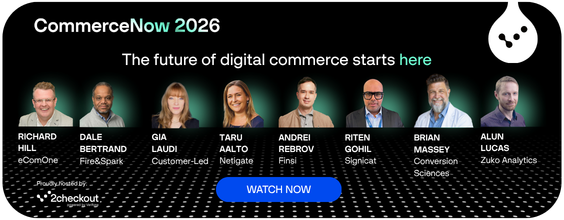
That question ran underneath three of the sharpest sessions at CommerceNow’26, 2Checkout’s tenth annual digital commerce event. Gia Laudi, Taru Aalto, and Andrei Rebrov approached it from different directions (positioning, customer signals, and AI agents) but landed in the same place. When output is commoditized, the durable advantage is understanding your customers more deeply than anyone else in your market and building the systems to act on that understanding faster than your competitors do. Here is how to build it.
When everyone can produce more, output stops being the advantage
Look at what has actually changed. Products are easier to build than ever. Campaigns are cheaper to launch. Content is effectively infinite. And every market feels saturated. The natural instinct is to respond with more: more tests, more channels, more variations. But there’s a catch. Reach for AI the same way everyone else does, and you get the same results everyone else gets.
Andrei Rebrov, co-founder of Finsi, made the point with a small experiment: ask five AI tools to pick a random number between 1 and 20, and they’ll almost all say 17. Large language models predict the most expected next token, so left to their defaults they produce the average: average hooks, average copy, average campaigns. In a crowded market, average is invisible.
Gia Laudi, co-author of Forget the Funnel, framed the deeper problem: you can’t execute your way to clarity. New heads of growth are expected to fail roughly 97% of the time in their first three months, fueled by advice to just get more at-bats. But at-bats without a system is activity without progress. And in a saturated market, only painkillers cut through: products positioned around a problem so specific and so felt that buyers can’t ignore them. You can’t position as a painkiller until you understand exactly what hurts.
So what should you do?
- Treat growth as an understanding problem, not an output problem. Before generating the next batch of creative, confirm you know the felt problem you solve, and for whom.
- Position around a specific, painful problem. Vitamins get deprioritized; painkillers get bought.
Knowing what happened isn’t the same as knowing why
Here’s the trap that catches sophisticated teams: you have more data than any team in history, and it still doesn’t tell you what to do.
Taru Aalto, Chief Customer Officer at Netigate, described the pattern. Teams can see what happened almost instantly: conversion dropping, cart abandonment climbing, churn creeping up, but ask why, and the room goes quiet. That gap is where growth leaks out. Operational data is the what: checkout completion, drop-off points, return and repeat-purchase rates. Experience data is the why: the reasons behind those actions. Growth happens when you join the two into a repeatable signal-to-action loop. Most companies already have both, scattered across checkout logs, reviews, support chats, and CRM. The first task isn’t collecting more; it’s bringing what you have into one view.
Bonus read: Solution Brief – Reporting & Analytics.
Laudi reached the same conclusion from the research side: aggregate data tells you what is happening, rarely why. Her example was an invoicing tool that ran constant experiments and generated plenty of signups but lost too many before they became long-term customers. Two groups hid in the data: a large, vocal, easy-to-please group with high satisfaction but low value, and a pickier, harder-to-win group with far higher lifetime value. For years the team lumped them together and let the loud, lower-value group shape the roadmap. The customers they should have optimized for were the ones they understood least. Knowing who your customer is (industry, size, job title) is not the same as understanding why they buy.
So what should you do?
- Add one open-text field to your signup flow: “What led you here today?” Then watch which answers become your happiest, highest-value customers.
- Read the words customers already give you in reviews, tickets, and cancellation notes. The free-text reason is usually truer than the radio button.
- Prioritize by impact and strategic fit, not by how often something gets mentioned.
Watch Taru Aalto’s full session as she shares how AI turns fragmented customer data into a real driver of growth and retention.

Understanding has a shelf life
Even teams that do this well make one quiet mistake: they treat customer understanding as a finished project rather than a signal that decays.
Laudi emphasized that customer circumstances change faster than research cycles. The job a customer hired you to do in 2024 may not be the job they need in 2026. In one engagement, a team re-ran research just eighteen months later and found an entire customer group had vanished while a new, more lucrative one had emerged. The old profile wasn’t wrong; it had simply expired.
Rebrov showed the cost of missing that shift. Picture a subscription brand scaling past a million in revenue with a lean, AI-assisted team. Everything works on day one. Four weeks later, as spend scales, acquisition costs climb and orders fall, though nothing in the process changed. Then a holiday campaign goes out to 14,000 subscribers and returns two orders, a pattern Rebrov noted mirrors a real customer. The failure wasn’t the tooling. The recipients were gift buyers, but the message spoke to product users, so it landed with no one. The brand had scaled far beyond its first 200 customers without re-running the diagnosis.
So what should you do?
- Put customer research on a cadence, not a shelf. Assume last year’s segments have drifted.
- Before a major campaign or repositioning, confirm you’re still speaking to who actually buys, and to why they buy today, not two years ago.
Discover our CommerceNow’26 session featuring Gia Laudi on why the brands that keep growing build recurring revenue relationships, not just recurring campaigns.

Turn understanding into action: build systems, not one-offs
Understanding your customers is necessary. It isn’t sufficient. The most common way it goes to waste is a failure mode Aalto named directly: teams get stuck in reporting because no one owns the action. The fix is a loop that runs from signal to action to result, not a report that gets read.
This is where AI earns its place. Aalto described it as changing the economics of listening: reading thousands of reviews, tickets, and surveys across dozens of languages doesn’t scale with people, but it does with AI, which unifies feedback, surfaces root causes, and prioritizes by business impact rather than volume.
Rebrov offered the operating model. Treat AI like a new hire and give it what any hire needs: context (what you sell, what’s worked, what hasn’t, what’s happening in your market), skills (written instructions for specific jobs, like evaluating a top-of-funnel campaign), and a schedule, so it runs proactively rather than only when prompted. Context plus skills plus schedule is what separates an agent that compounds from a chatbot that produces 17. Two guardrails: keep a human in the loop for anything unusual, and don’t let AI do your arithmetic. Hardwire how core metrics are calculated, then use AI to explain them.
So what should you do?
- Wrap a loop around one recurring decision and give it an owner. The goal isn’t a smarter report; it’s a repeatable path from a customer signal to a change you actually ship.
- Give any AI agent context, skills, and a schedule, then check its work, because these systems still hallucinate
Check out Andrei Rebrov’s session on how to achieve 3x growth on autopilot with 5 AI agents.

Start small, prove it, then expand
The instinct, once this clicks, is to build the grand system, with every stage instrumented, every source connected, every agent live. All three speakers warned against it.
Aalto’s advice was to resist boiling the ocean. Pick one moment in the customer journey, connect a few signals you already have, and close a single loop. Your data doesn’t need to be perfect; you need a decision loop and the discipline to act on it. Rebrov’s on-ramp was even more concrete: automate one thing you already do by hand, like a daily summary of sales, opens, and acquisition cost posted to Slack each morning. If you’re choosing where to begin, start with a monitoring agent that tells you when something breaks, because a silent broken plugin or an unexplained cost spike can quietly burn money for weeks.
But the hardest part isn’t technical, and both Aalto and Laudi said so plainly. The real constraint is the operating model: whether your teams actually look at customer signals and act on them. You change that by proving value in one place, showing the result, and letting the proof create pull across the organization. Enthusiasm spreads faster than a mandate.
So what should you do?
- Choose one journey moment, connect the signals you already have, and build one loop with a clear owner.
- Prove the result, share it, and expand only once the numbers are stable and the experience is easy to explain.
Bonus read: Customer Acquisition – Strategies & Techniques.
Bringing it together
Strip these three sessions down and the same shape appears. Better models are available to everyone. More agents are available to everyone. Infinite content is available to everyone. None of it is a moat, because none of it is scarce.
What stays scarce is knowing your customers (what they’re struggling with, why they chose you, and what value looks like from their side of the screen) and having the operating system to turn that knowledge into action before the market shifts again. That understanding is what lets you position as a painkiller instead of a vitamin, speak to gift buyers instead of users, and fix the checkout friction quietly costing you revenue. The tools change every few months. The advantage of understanding your customers better than your competitors does not.
Want the full playbooks behind these takeaways?
CommerceNow’26 has wrapped, but the full sessions from Gia Laudi, Taru Aalto, and Andrei Rebrov go deeper than any recap can. Watch them on demand at Commerce Now ’26, then explore how the 2Checkout Monetization Platform helps you turn customer understanding into retention and revenue.