

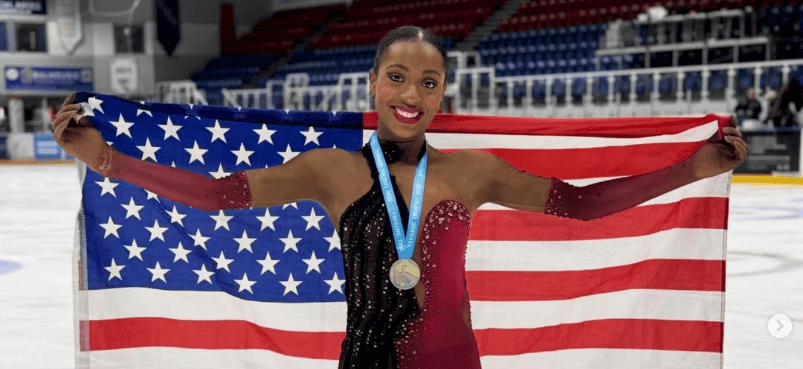
The jump lasts less than a second, but this one was decades in the making. On Saturday, November 14, at Skate America in Everett, Washington, 23-year-old American figure skater Alexa Gasparotto opened her short program with a clean triple axel. With that landing, she became the first Black woman ever to land the jump at an International Skating Union (ISU) Grand Prix event.
The moment has picked up steam all week, including a TIME column on why it matters well beyond the scoreboard. It does, and here is the full story.
Why the Triple Axel Is Such a Big Deal
The axel is the only jump in figure skating that takes off going forward, which means a triple axel requires three and a half rotations in the air before the skater lands backward on one blade. It is widely considered the most demanding triple jump in women’s skating, and very few women in the world attempt it under competition pressure.
American history with the jump is short and memorable. Tonya Harding became the first U.S. woman to land it in competition in 1991, and Mirai Nagasu became the first American woman to land one at the Olympics in 2018. When Gasparotto landed her first competitive triple axel at the Maria Olszewska Memorial in Poland in March 2025, she became only the eighth U.S. woman to do it in competition, and the first Black woman. Now she has done it on the Grand Prix stage, the sport’s top international series outside of the Olympics and World Championships.
Her Grand Prix Debut in Everett
Skate America was Gasparotto’s first-ever Grand Prix assignment, and she did not ease into it. She opened her short program, skated to a blend of versions of “Make You Feel My Love,” with the triple axel and earned 10.63 points for the element. According to Just Women’s Sports, that was the highest score for a triple axel among the four women who tried the jump in Everett.
The rest of the program was not perfect. A planned jump combination came out as a double Lutz-double toe loop, and she finished 12th after the short program. Still, her short program score of 56.04 was a personal best, and she finished 11th overall with 152.77 points.
As someone who runs a site built to celebrate Black achievement, I don’t think the final placement is the headline here. Debuts at this level are about proving you belong, and opening your first Grand Prix program with the hardest jump in your arsenal is about as clear a statement as an athlete can make.
Standing on the Shoulders of Pioneers
Gasparotto’s landing is part of a longer story about Black women in a sport that has not always made room for them.
- Mabel Fairbanks was shut out of competitive skating because of her race in the mid-20th century and went on to coach and champion other skaters. U.S. Figure Skating’s Mabel Fairbanks Skatingly Yours Fund, which supports skaters of color, carries her name, and Gasparotto was a 2023 scholarship recipient.
- Tai Babilonia became the first Black figure skater to compete at the Olympics in 1976.
- Debi Thomas won bronze at the 1988 Calgary Olympics and remains the only Black Olympic medalist in women’s singles.
- Surya Bonaly famously landed a backflip on Olympic ice at the 1998 Nagano Games.
- Starr Andrews became the first Black woman singles skater to medal on the Grand Prix circuit.
What stands out to me most is that this history reads like a relay. Each of these women carried the sport a little further and made the next generation’s goals look a little more reachable. Gasparotto has now added her own leg to that race, and it is one that future skaters will be able to point to by name.
“Coach Lexi” and the Next Generation

Gasparotto started skating at age 4 in Canton, Michigan, and now trains in Buffalo Grove, Illinois. Off the competitive ice, she has spent about two years teaching at the Glenview Community Ice Center, where young students know her as “Coach Lexi,” according to Patch. She also won her first international medal in October 2025, a sign that her breakthrough has been building steadily rather than arriving overnight.
That teaching role gives her historic jump an extra layer of meaning. Speaking about the young skaters who look up to her, she told U.S. Figure Skating, “I can’t wait to just be a mentor to them.”
I find that part of the story the most encouraging. Representation matters most when the person being represented is still close enough to reach back, and a skater who is landing history-making jumps on weekends and lacing up kids’ skates during the week is doing exactly that.
What Comes Next
Gasparotto is now two-for-two on the triple axel in international competition, and the jump gives her a scoring weapon few skaters anywhere can match. Consistency on the rest of her elements will decide how high she climbs, with the domestic championship season ahead this winter.
Whatever happens on the scoreboard from here, the record is already written. A Black woman has landed a triple axel on the Grand Prix stage, and every young skater watching now knows it can be done.
Sources: TIME, U.S. Figure Skating, Just Women’s Sports, Patch, and the New York Amsterdam News.
