

Indian Americans seemed to be trending towards the GOP. Then came a ton of racism.
Chris Rufo wears many hats—infamous culture warrior, fellow at the right-wing Manhattan Institute think tank, nakedly cynical enemy of diversity initiatives and Critical Race Theory, serial fabulist. And, since this is 2026, Rufo also has his own podcast, Rufo and Lomez, which he cohosts with Jonathan Keeperman on Blaze TV. This past September, an episode of Rufo and Lomez caused a wave of controversy by its title: “The Indian Question.”
The phrase is a winking provocation, a deliberate throwback to previous generations’ racialized “questions” (the “Jewish question” or the “Catholic question”). But there was nothing funny about Rufo’s message: that Indian Americans’ alleged resistance to assimilation, coupled with their collective capture of elite institutions, such as universities, threatens the cultural heritage of the United States. “Even if there might be trade-offs for keeping some amount of immigrants out who are high-skilled and might be a benefit to the economy, I like having a high-trust society,” Keeperman remarks during the podcast. “I like living somewhere where there is cultural cohesion, where I have this unspoken affinity with my neighbors.”
Of course, this is a childish view of cultural kinship and cohesion—one that fuses trust with skin color, as if all white Americans shared the same values and trusted one another the same. It’s difficult to take figures like Keeperman and Rufo seriously. The former is an erstwhile anonymous Twitter troll, and a friend to open white nationalists such as Steve Sailer. The latter is far more prominent, best known for spreading the racist lie in 2024 that immigrant Haitians in Ohio were eating their neighbors’ cats. But Rufo is nothing if not an opportunist, a shapeshifter who senses where the political winds might be blowing and moves accordingly. John Ganz astutely describes him as “a political entrepreneur… identifying conflicts developing on the right and translating cultural controversies into politically usable concepts and then into institutional campaigns.”
Rufo’s engagement with the “Indian Question” is revealing—if not for its substance, which is just faux-intellectual babble that aims to inflame, then as a sign of the present conservative approach to immigration.
By the end of the 20th century, the debate largely hinged on the axis of good “legal” and bad “illegal” immigration. The latter, it was thought, should be policed; the former wasn’t only tolerated but exalted as a monument of the American promise, a shibboleth held by Democrats and most Republicans alike. That consensus began to crack over the years of the Obama presidency, which saw Republicans repeatedly detonate efforts to substantively reform immigration laws (all while Obama presided over a historic deportation operation).
The last decade of American politics has shattered these shibboleths, thanks to a reinvigorated nativist conservative base powered by the rise of Donald Trump. These days, conservative discourse on immigration is littered with chilling, fantastical concepts such as “remigration” (the forced repatriation of immigrants and their descendants back to their home countries), and “Heritage Americans” (a category that defines “real” Americans on openly racial lines).
Current Issue
Figures like Rufo have long sought to harness this raucous, eliminationist spirit, and inject it into the heart of contemporary Republican Party politics. They’ve largely succeeded, and today, the status quo on immigration has been upended: Over the last year and a half, undocumented immigrants have been subjected to a fascist, murderous blitz; now “legal” immigrants have also come into the crosshairs of conservative politicians.
Two years ago, the Republican Party appeared to be on the brink of a breakthrough with Indian American voters, a historically solid Democratic bloc. Twenty-two percent of Indian American voters supported Trump’s 2020 campaign; that number shot up to 30 percent in his 2024 campaign. If Republicans could have siphoned more Indian American voters this cycle, that could have potentially affected margins of swing seats in states such as Georgia, North Carolina, and Texas. Yet, perhaps owing to the recent surge in conservative anti-Indian rhetoric, Republican gains with Indian American voters have evaporated.
Even as this new consensus was decisively rebuked in the midterms, though, it remains the dominating paradigm of American immigration—and in both interesting and pressing ways, it has touched the politics of the Indian American diaspora as well.
The present anti–Indian American phenomenon began as an outgrowth of an intra-conservative debate about the H-1B visa system, which permits tens of thousands of foreign, high-skilled workers to immigrate to the United States and work for American companies. Indian immigrants account for nearly three-quarters of H-1B visa holders, and have thus become emblematic of both the H-1B system and its alleged “abuse.” Right-wing opponents generally see the H-1B as a mechanism for job-stealing foreigners to enter America through the back door.
Some of the more enterprising firebreathers, such as Steve Bannon, talk about the program as enabling “corporate greed,” shrouding their critiques in a thin tissue of populist rhetoric (for many of this ilk, these were the first—and perhaps only—comments on corporate excess they’ve ever levied). In recent months, the Trump administration, facing historically low approval ratings and anemic enthusiasm going into the midterms, announced further restrictions to the process. As expected, the reforms roused the GOP base, jolting a fresh round of discourse around both the visa and Indian immigration.
Critiques of the H-1B system often blur into outright xenophobia—an unsurprising development when considering how much of contemporary conservative politics is powered by its white nationalist bloc. The best-known example of this came in September, when a Texas Republican candidate named Bo French reposted a photograph depicting a group of South Asian students celebrating a University of Texas–Austin football win. “I heard UT graduation this year looked like this,” he laments. “I didn’t believe it. The problem is now obviously far worse than anyone imagined.”
French’s comments attracted widespread condemnation, yet his sentiment was far from exceptional. In January, Aaron Reitz, a former Texas GOP candidate who currently serves as a United States Attorney for the Southern District of Texas, tweeted about the “invasion of un-assimilated & unassimilable Indians,” before calling on the Trump administration to “Deport most. Assimilate the rest.”
Another story from earlier this year, which circulated widely across the right-wing media ecosystem, highlighted the Dallas suburb of Frisco. Around 20 percent of Frisco’s residents are of Indian descent, and many of them are H-1B visa holders, a fact that prompted conservative talking heads to warn of Frisco’s “Indian takeover.” Riled-up activists flooded Frisco City Hall meetings, where they often ripped into Burt Thakur, one of the city’s council members—ironically, an Indian American Trump supporter.
On the federal stage, two of the most vocal critics alleging H-1B abuse are Vice President JD Vance and Republican Texas Representative Brandon Gill. Vance recently referred to H-1B workers as “indentured servants”; Gill, a 32-year-old with a massive and rabid online following, tweeted, “We don’t need to import 7-Eleven workers from India or anywhere across the globe. Hire Americans.”
The profound irony is that both Vance and Gill have married Indian American women; they are fathers to Indian American children. Yet both have gladly offered up their families as tributes to the white nationalist meat grinder sustaining massive swaths of their governing coalitions. Indeed, many others have made this observation in recent months, but perhaps none more noteworthy than the shrill antisemite and white supremacist Nick Fuentes, in a recent jeremiad excoriating the contemporary right’s lack of authenticity.
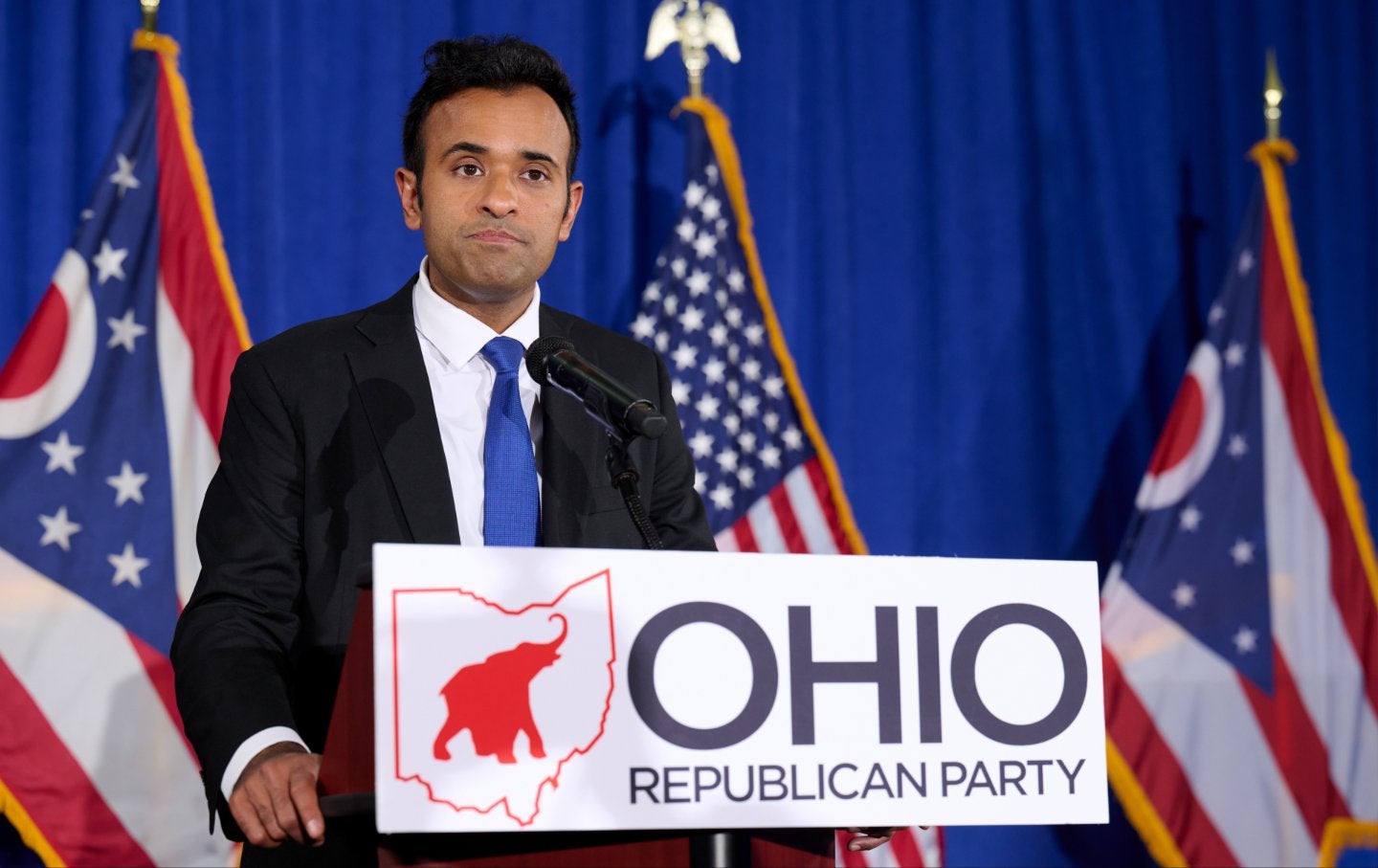
Vivek Ramaswamy, one of the most contemptuous figures in American politics, is a key figure in this conversation—an exemplar of the tightrope act that today’s conservatives of color are forced to walk. His Indian ancestry was a key liability during his 2024 presidential campaign, and continued to drag down his chances during his ill-fated Ohio gubernatorial campaign. Last December, he took to The New York Times to try to stake some moral high ground, writing that “it is downright unacceptable to spew poison toward Jews, Indians or any other ethnic group.”
Unfortunately for Ramaswamy, this “righteous” declaration is painfully out of step with contemporary Republican politics (to say nothing of his otherwise heinous campaign). Ahead of the election, right-wing pundit Erick Erickson described Ohio’s polling as “pretty bleak,” a fact he partly attributes to how “the white nationalists…don’t want to support Vivek Ramaswamy for governor.”
Ramaswamy ultimately lost the governor’s race by nearly eight percentage points, a humiliating defeat that will usher in Ohio’s first Democratic governor in a decade and a half. “Look at what’s happening in Dearborn, Michigan. We’re not going to let that come to our state of Ohio,” he warned at one of his final campaign speeches. It’s a Lynchian scene: a brown-skinned Hindu warning about brown-skinned Muslims, trusting that a political movement, composed of a growing number of white nationalists, will make the distinction between the “good” and the “bad” brown-skinned immigrant.
Yet this dissonance hasn’t slowed an odd set of right-wing influencers of Indian descent from unloading on the H-1B program—and in the process, slipping between the critiques of the visa and Indians writ large. Nalin Haley, son of former South Carolina governor and UN Ambassador Nimrata “Nikki” Haley, is an influencer with over 50,000 followers across social-media platforms, and has frequently called for the complete termination of the program. But his comments, too, have occasionally blasted the Indian nation-state more broadly: “They send cheap labor to the US, buy cheap oil from Iran, and cheap weapons from Russia because they have a cheap government.”
Popular
“swipe left below to view more authors”Swipe →
Another influencer, one Priya Patel, who boasts a cumulative following of nearly 200,000, has also coupled her critiques of H-1B with scathing comments that implicate her own ancestry. “Not all cultures are equal, and we shouldn’t be importing the third world,” she once tweeted, before later describing India as the “third world.”
To witness these Indian Americans contort their identities to fit the shell of nativist Americanism is absurd, even carnivalesque. Perhaps they feel like they can singe off their Indian inheritances in exchange for unconditional entry into the fraternity of “America.” One quick scroll on their social-media accounts and we’re reminded just how wishful this thinking is—at any given time, you’ll find troll accounts disparaging these Indian American influencers as “jeets,” the preferred anti–South Asian slur of the online right.
In Texas, the anti-Indian fight has harmonized well with an existing Islamophobic panic around “Sharia law” currently possessing Texas conservatives. To right-wing, nativist Texans, it appears that both invasions are two sides of the same coin. In the aftermath of the midterm results, one conservative influencer commented, “This is what happens when you import Muslims and Indians into Collin County,” accompanied by a screenshot showing Collin swinging toward James Talarico (Collin contains part of Frisco, as well as Plano, another city that right-wingers have seized upon in their anti-H1B hysteria).
But the Hindu American Foundation, a noxious organization that has long served the interests of rich, right-wing Indian Americans, is trying to cleave anti-Indian hate from anti-Sharia panic. Not only does it wish to justify the latter, it also cosigns the notion that Hindus are well-suited to combat Sharia—a misguided strategy that only fans the flames of bigotry. And beyond its reprehensible moral approach, it’s a hopelessly naïve effort given the symbiotic relationship between anti-immigrant and anti-Muslim politics—a pathetic appeal that rhymes with those scenes of Ramaswamy begging white nationalists for their support.
As surreal as this entire spectacle remains, it’s not without its material consequences. According to one report by Stop AAPI Hate, the proliferation of anti-South Asian slurs online more than doubled between January 2023 and December 2025. “Threats against South Asians,” the report reads, “comprised 71% of all anti-Asian threats between August 2024 and December 2025.” Just this weekend, a right-wing activist and his followers stormed a Seattle Diwali event brandishing signs that read “Deport All Dot Heads” and “Stop Hindu Replacement of Christians.” Over recent months, following the tragic news of an undocumented Sikh truck driver’s fatal crash that killed three people, Sikh Americans were particularly targeted—both by online right-wing mobs, as well as the Department of Homeland Security. “I can’t wait till ICE swipes your ass with your H1-B and deports you via shipping container,” one anonymous right-winger tweeted to Jyot Singh, a recently elected Sikh American Georgia state representative.
Last month, a 19-year-old neo-Nazi stormed a Hindu temple in Illinois, where he intended to carry out a mass shooting. Miraculously, his rifle misfired and no one was injured. His manifesto, which allegedly derides Black, Jewish, and Indian Americans as “subhuman,” offers a clear glimpse into the ideology underpinning contemporary white supremacist radicalism. According to news reports, authorities found a gas can at the attacker’s home. The label read “Jeet Remover.”
More from The Nation
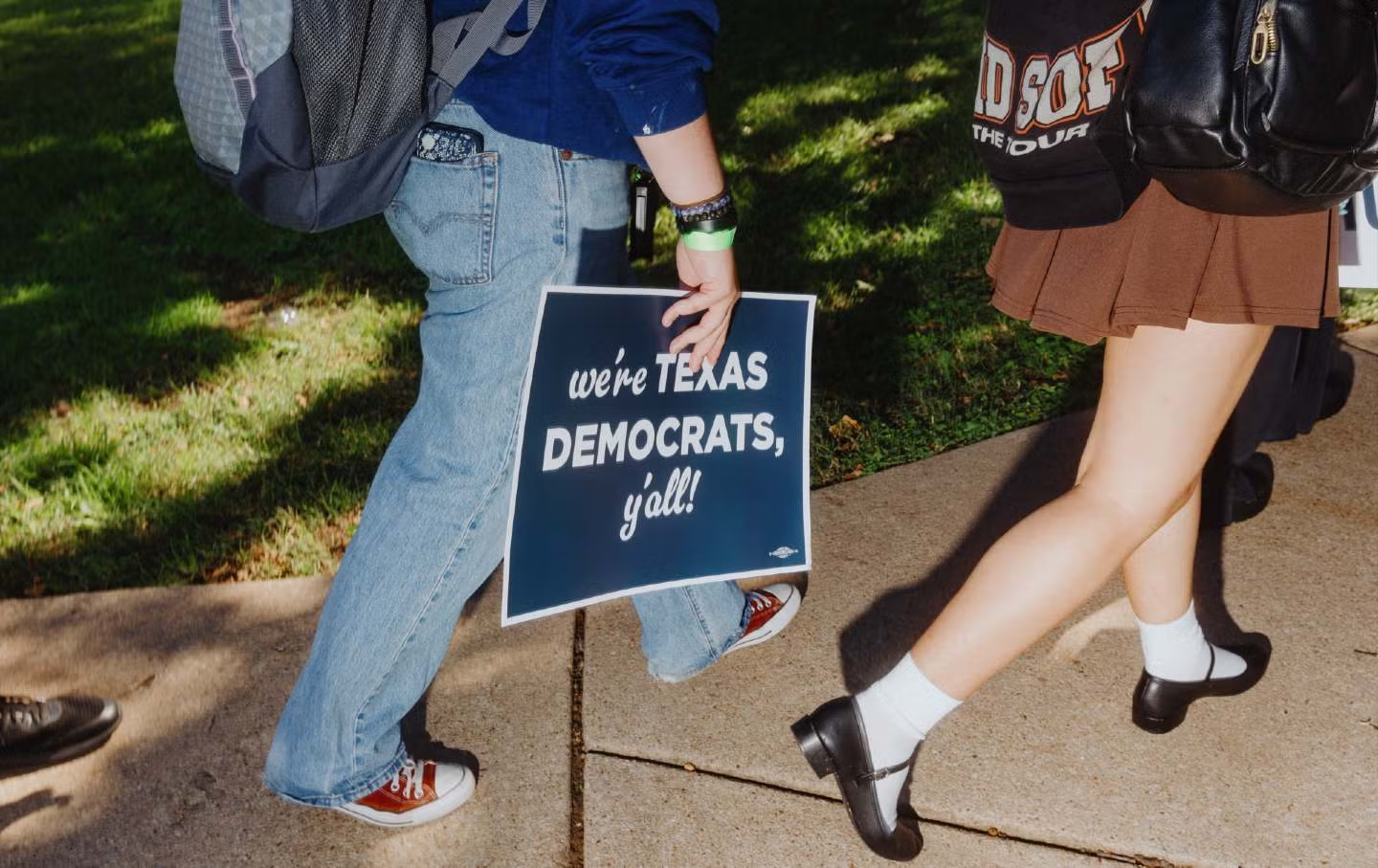
After years of Republican dominance, Texas Democrats won statewide with overwhelming support from young voters.
Who is going to fix all the things the Republicans, corporations, and tech titans broke?
The big winners are anti-China hawks in the national security establishment and OpenAI and Anthropic.
Children and families turned creativity into a call for housing justice, educational equity, immigrant rights, and community solidarity at the Children’s Rally for Justice.
