

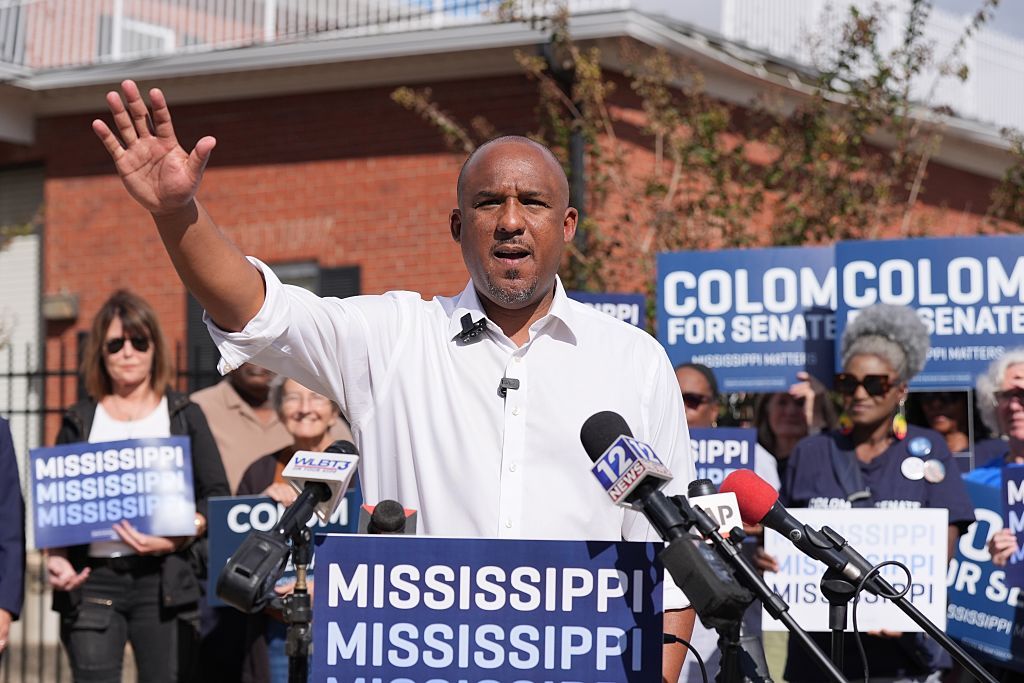
Mississippi’s close senate race remains unresolved as ballot monitors report obstacles to observing the vote count and thousands of ballots await verification. Democrat Scott Colom maintained a narrow lead over Republican incumbent Sen. Cindy Hyde-Smith as of Saturday, Nov. 7, with election officials facing a critical deadline to finalize outstanding ballots.

According to AP, Colom led Hyde-Smith by 2,574 votes, with approximately 97% of expected ballots counted. Outstanding absentee and affidavit ballots could determine the outcome ahead of a Tuesday, Nov. 10, deadline.
A statewide victory would make Colom Mississippi’s first Black U.S. senator since Reconstruction. However, as Mississippi awaits its final results, voting rights advocates say confusion surrounding the counting process and voter registration records is creating additional challenges for voters and election observers.
Ballot Monitors Report Obstacles As Mississippi Counts Votes
In Capital B News, volunteer ballot monitors across Mississippi have reported difficulty accessing counting locations, obtaining accurate schedules and observing election officials as they review outstanding ballots.
Natt Offiah, director of organizing for the People’s Advocacy Institute, told the outlet that he and a colleague were repeatedly redirected while attempting to observe ballot counting in Madison County. After arriving at the circuit clerk’s office, they discovered the building was under construction and spent hours searching for the correct location.
“There is no standardized process for counting. Each county can pick and choose when they want to start counting. So, we’re running into this runaround issue,” Offiah said.
Similar concerns emerged in DeSoto County, where organizer Kelly Jacobs alleged that election officials initially prevented her from observing ballot processing. Capital B reported that public observation was eventually permitted, although Jacobs said work had already begun.
DeSoto County Election Commissioner Laura Edler disputed allegations that observers were denied access, telling the outlet that members of the public were actively watching the process.
The Mississippi secretary of state’s office also clarified that state law allows public observation when election commissioners announce whether affidavit ballots are accepted or rejected. However, preliminary reviews to determine voter eligibility are not subject to the same public access requirements.
Capital B reports that beyond monitoring concerns, Mississippi’s voter roll maintenance practices have raised questions about whether eligible voters were mistakenly classified as inactive.
In Capital B, the secretary of state’s office paid $50,000 to use unverified commercial data from credit bureau Experian to update voter registration records ahead of the election. Thousands of voters were subsequently moved to inactive status, contributing to concerns about the number of affidavit ballots requiring additional review.
One DeSoto County voter, Rachel Madden, told Capital B that she discovered her registration had been marked inactive after waiting approximately an hour to vote on Election Day.
Despite never changing her address, Madden said she was instructed to cast an affidavit ballot and travel approximately 25 minutes to the courthouse to correct her registration.
Once there, Madden learned that records indicated she had moved to Memphis, Tennessee, a claim she disputed. Although her address was corrected and she received a new voter registration card, she said she encountered additional difficulties confirming whether her ballot would count.
“Even in person that day, they were not helpful. If I had not insisted, I don’t think they would have done it. I just don’t think that’s fair or right,” Madden said.
Edler told the outlet that voters flagged for address changes must resolve the issue to restore their active registration status.
According to Capital B, the NAACP and other voting rights organizations have deployed legal personnel and volunteers across Mississippi to monitor the counting process and advocate for transparency.
Colom’s Lead Widens As Critical Ballot Deadline Approaches
While voting rights advocates raise concerns about election procedures, MS.NOW reports that the remaining ballots could determine one of Mississippi’s most closely watched Senate races.
MS.Now states that the Secretary of State Michael Watson said 11,202 affidavit ballots had been processed as of Friday, Nov. 6, with approximately 78% accepted. Watson acknowledged that his office did not know how many remained outstanding, while Colom’s campaign estimated that as many as 15,000 affidavit ballots could have been cast statewide.
The uncertainty comes as Mississippi approaches its Nov. 10 deadline for verifying affidavit ballots and receiving eligible absentee ballots postmarked by Election Day.
Colom criticized the state’s voting restrictions, telling MS.NOW that he had repeatedly advocated for early voting and making Election Day a federal holiday.
“We got to make voting accessible in this country,” Colom said.
Watson defended Mississippi’s election security measures, maintaining that the procedures were designed to prevent ineligible voting.
“We have implemented every available resource to ensure our elections are secure, and to ensure we do not have dead people, illegal aliens with fake addresses, or nonresidents voting in our elections,” Watson said in a statement.
Meanwhile, both Senate campaigns have deployed attorneys as they prepare for potential legal challenges. According to MS.NOW, Mississippi does not have a general statutory recount procedure for the race, although a court can order one.
Hyde-Smith’s campaign expressed confidence that outstanding ballots from Republican-leaning counties would strengthen her position.
“We believe thousands of votes remain to be counted from dozens of Republican counties, and we are confident those votes will reinforce her path to victory,” her campaign said.
Colom also expressed confidence in his campaign’s position, telling MS.NOW, “I know that absentee and affidavits trend Democratic. We’re going to win.”
Colom Makes History In County Named After KKK Leader
While Mississippi’s statewide results remain uncertain, Colom has already made history in a county with deep ties to the Confederacy.
According to NewsOne, citing the Mississippi Free Press, Colom flipped Forrest County, which is named after Nathan Bedford Forrest, a Confederate general, slave trader and the Ku Klux Klan’s first grand wizard.
With approximately 97% of the county’s votes counted, Colom led Hyde-Smith 54% to 44%, marking a significant political shift from the 2024 presidential election, when President Donald Trump carried the county 58% to 40%.
The result is particularly notable given Forrest County’s history surrounding Black voting rights.
NewsOne reports that residents narrowly rejected a proposal to remove a Confederate monument outside the county courthouse in Hattiesburg in 2020. The monument, erected in 1910, stands across from a memorial honoring Vernon Dahmer, a civil rights activist murdered after Ku Klux Klan members firebombed his home in 1966.
Dahmer, who fought to expand Black voter registration in Mississippi, is remembered through a statement engraved on his memorial: “If you don’t vote, you don’t count.”
NewsOne also highlighted Hattiesburg’s role in the 1964 Freedom Summer movement, when organizers established freedom schools and fought discriminatory voter registration practices that prevented Black Mississippians from exercising their constitutional rights.
More than six decades later, Colom’s performance in Forrest County adds historical significance to an election already drawing national attention.
For now, the statewide race remains undecided, with election officials continuing to review outstanding ballots ahead of Tuesday’s deadline.
