

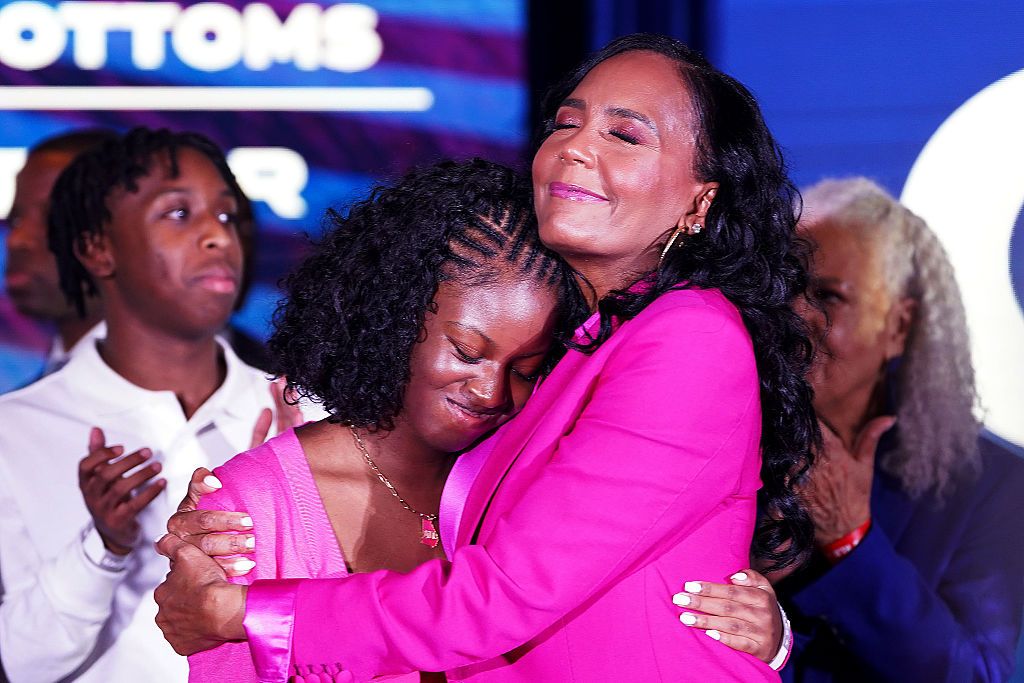
There are plenty of places you can go to find the numbers that explain how Keisha Lance Bottoms became governor-elect of Georgia.
This is not that story.
This is an unconventional evaluation of a historic moment.

I want to talk about some other numbers.
84.
22.
3/3.
January 13.
January 18.
And then I want to talk about a cemetery in Crawfordville, Georgia. A little Black girl staring out of a car window. An HBCU on the highest of seven hills. Twenty-two Black women who decided more than a century ago that their sisterhood would be connected to public service. A great-great-grandmother born before emancipation. And generations of prayers offered by people who never got to see the answer.
Because sometimes history needs more than an electoral map to explain itself.
One coincidence can be dismissed as happenstance.
Two might make you raise an eyebrow.
But when happenstance begins stacking itself on top of happenstance—when the people, the dates, the institutions, the memories and the places begin touching each other across generations—it can start to feel like something else.
A foundation.
Foundations create movement.
And sometimes enough movement creates wind.
Maybe you call that alignment.
Maybe you call it ancestry.
Maybe you call it God.
Maybe you call it coincidence and keep reading.
I am not here to tell you which one it is.
I am simply saying that on November 3, 2026, Georgia elected Keisha Lance Bottoms governor. She will become the first Black woman in American history elected to lead a state, as well as Georgia’s first Black governor and first woman governor.
And when you look at everything surrounding that moment, there sure is a lot of wind.
Before There Was 84, There Were 22
Bottoms attended Florida A&M University, where she pledged Delta Sigma Theta Sorority, Incorporated.
The AJC traces that part of her journey directly through FAMU and Delta before law school, the judiciary, Atlanta City Council, the mayor’s office, the White House, and now the Governor’s Mansion.
That can be written as one line in her biography.
Or we can interrogate what that line actually means.
And before I do that, let me be clear about my relationship to this part of the story:
I am not Greek. I do not belong to a Divine Nine organization.
But you do not have to wear the letters to recognize the power of the institutions.
You do not have to be a member to understand the grandeur attached to them, the histories they carry, or the networks of scholarship, service, leadership, civic engagement, and kinship Black Greek-letter organizations have built for more than a century.
The Smithsonian’s National Museum of African American History and Culture describes these organizations as emerging during one of America’s most hostile periods of race relations, creating spaces rooted in racial uplift, community service, civic action and kinship at a time when Black students were routinely excluded from white Greek life.
We have seen how important that cultural context can become when history is being made.
When Kamala Harris became vice president, her connection to Howard University and Alpha Kappa Alpha Sorority, Incorporated was not some irrelevant footnote floating beside the accomplishment. It became part of how millions of people understood the woman standing in that historic moment. Howard itself identifies AKA as one of Harris’ formative campus affiliations.
AKA did not elect Kamala Harris.
Howard did not cast the electoral votes.
But the pink and green mattered to the cultural story.
Howard mattered.
The lineage mattered.
Not because symbols replace substance.
Because lineage gives substance context.
Keisha Lance Bottoms deserves that same fullness.
The crimson and cream matters here.
FAMU matters here.
Delta Sigma Theta matters here.
Delta Sigma Theta was founded at Howard University on January 13, 1913, by 22 Black college women. Congressional records recognizing the sorority’s history document those 22 founders and more than a century of scholarship, service, and political engagement.
And almost immediately, those women walked their new organization into public life.
On March 3, 1913, members of the newly formed Delta Sigma Theta participated in the historic Woman Suffrage Procession in Washington, D.C. The National Archives documents 22 Delta women among the thousands who marched that day, even as Black women confronted racism within the suffrage movement itself.
Delta’s own historical materials identify participation in that suffrage march as the sorority’s first act of public service.
Think about that for a second.
These young Black women had barely finished building the organization before they took it into the streets.
Before generations knew the crimson and cream.
Before the conferences.
Before the step shows.
Before the pictures.
Before thousands upon thousands of Black women would proudly carry those letters into classrooms, hospitals, boardrooms, courtrooms, and halls of government.
The first public footprints of Delta Sigma Theta were political ones.
Black women marching for access to a democracy that had not yet decided to fully include them.
And 113 years later, one of the women formed inside that sisterhood will govern an American state.
That did not elect Keisha Lance Bottoms.
But it is part of the ground beneath her feet.
And Since We’re Looking At Numbers…
At her victory celebration, Bottoms told Georgia, “I am honored to be your 84th governor.”
So let’s play with 84 for a moment.
Eight plus four equals 12.
One plus two equals three.
And Delta’s historic suffrage action happened on:
3/3.
Now, nobody needs to call Miss Cleo.
Numerology did not count the ballots.
But Black people have always known how to hold fact and symbol at the same time.
We can know exactly how an election was won and still notice the poetry surrounding it.
In popular numerology, eight is associated with accomplishment, power, and achievement, while four is associated with practicality, organization, and foundation.
Power resting on foundation.
Again:
Happenstance?
Maybe.
Put it on the pile.
Because then we have to talk about those 22 founders.
Within numerological traditions, 22 is commonly described as the “Master Builder”—symbolically associated with taking something imagined and creating something tangible enough to last beyond you.
Twenty-two Black women built Delta Sigma Theta.
More than a century later, one of the women standing on what they built is making history none of them lived long enough to witness.
I am not saying the number made it happen.
I am saying that at some point coincidence becomes a very interesting word.
Even The Calendar Is Talking
Delta Sigma Theta was founded on January 13.
Keisha Lance Bottoms was born January 18.
Five calendar days apart.
Both dates sit in Capricorn season, conventionally identified as running from late December through January 19.
If you know anything about the popular mythology surrounding Capricorns, the language is almost too easy: discipline, ambition, practicality, determination, building slowly and staying long enough to finish.
But there is another date.
On January 2, 1788, Georgia became the fourth state to ratify the United States Constitution.
Another Capricorn date.
So the woman who will become the first Black person and first woman to govern Georgia shares an astrological season with both the state she will lead and the sisterhood that helped shape her.
Does that mean the stars elected her?
Of course not.
But come on.
We’re allowed to enjoy history when it gets cute.
Especially because underneath the astrology is something much more substantial.
Institutions.
Both Georgia and Delta Sigma Theta existed long before Keisha Lance Bottoms arrived.
One was a state whose government once protected slavery and segregation.
The other was an institution created by Black women determined to increase what was possible for themselves and their communities.
More than a century later, a woman shaped inside one of those institutions has been elected to lead the other.
That is not astrology.
That is history.
The Deltas Have Been Opening Doors For A Minute
Keisha Lance Bottoms is not the beginning of Delta’s relationship with political firsts.
She is another chapter.
Congressional records recognizing Delta Sigma Theta specifically place Shirley Chisholm, Barbara Jordan, and Carol Moseley Braun within its lineage of public servants. Congressional record honoring Delta Sigma Theta’s political legacy
Shirley Chisholm became the first Black woman elected to Congress and later the first Black woman to seek the presidential nomination of a major American political party.
Barbara Jordan became the first Black woman elected to the Texas Senate, and later the first Black woman from the South elected to the United States House of Representatives. Congressional tributes to Jordan also document her membership in Delta Sigma Theta. Congressional Record: Barbara Jordan and Delta Sigma Theta
Carol Moseley Braun became the first Black woman to serve in the United States Senate. U.S. Senate Historical Office: Carol Moseley Braun
These women did not have identical politics.
They did not have identical careers.
They did not understand power in identical ways.
That is not the point.
The point is accumulation.
One Black woman enters a room.
Then another.
Then another.
And every entrance changes what the next generation understands to be possible.
Chisholm enters Congress.
Jordan enters Congress from the South.
Moseley Braun enters the Senate.
And now Keisha Lance Bottoms enters a category that, for the entire history of this country, has never contained a Black woman:
Governor.
This is where the crimson and cream stops being decoration around the story.
It becomes part of its infrastructure.
And recognizing that does not require those of us outside Delta—or outside the Divine Nine altogether—to appropriate the sisterhood.
It requires us to respect these institutions enough to understand what they built.
The same is true across the Divine Nine.
Different letters. Different colors. Different histories and traditions.
But collectively, these organizations have created networks of Black education, scholarship, leadership, professional development, mentorship, civic engagement, and service.
We sometimes talk about Black excellence as if extraordinary Black people simply fall from the sky fully formed.
They do not.
People grow inside ecosystems.
Somebody built the chapter.
Somebody endowed the scholarship.
Somebody mentored the student.
Somebody organized the voter drive.
Somebody wrote the recommendation.
Somebody made the introduction.
Somebody told a young Black woman:
You belong in that room.
That is how institutions become wind.
There Really Was No Place Like The Hill
And then there is FAMU.
Just days before Georgia elected Bottoms, Florida A&M University wrapped its 2026 Homecoming celebration.
The theme?
“There’s No Place Like the Hill.”
The university’s official Homecoming celebration ran October 18 through October 25, drawing generations of Rattlers back to Tallahassee for a week explicitly centered on tradition, Greek pride, memory, and connection. FAMU: 2026 Homecoming — “There’s No Place Like the Hill”
Just over a week later, one of the Hill’s daughters became the first Black woman elected governor in American history.
Again:
Happenstance.
Maybe.
But stay with me.
The Beta Alpha Chapter of Delta Sigma Theta Sorority, Inc. was chartered on the FAMU campus on January 30, 1937.
Decades later, Keisha Lance Bottoms would become part of that lineage.
And if you map her larger ecosystem, the journey looks something like this:
Atlanta Public Schools.
Frederick Douglass High School.
Florida A&M University.
Delta Sigma Theta.
Georgia State University College of Law.
The judiciary.
Atlanta City Council.
The mayor’s office.
The White House.
And now the Governor’s Mansion.
That list matters because it allows us to see something our obsession with individual achievement can obscure:
Keisha Lance Bottoms did not arrive at this moment alone.
None of us do.
A person may be the name history records, but behind almost every historic first is an ecosystem filled with names history will never know.
Professors.
Sorors.
Teachers.
Grandmothers.
Neighbors.
Campaign workers.
Church mothers.
Mentors.
Friends.
People who slipped somebody $20.
People who offered a couch.
People who made a phone call.
People who prayed.
The person may walk through the door alone.
But there are always fingerprints on the doorknob.
Before The Governor’s Mansion, There Was Crawfordville
And this is where all of those interesting little alignments stop feeling cute.
The day before Election Day, Keisha Lance Bottoms went to Crawfordville, Georgia.
Not simply to campaign.
To remember.
Her family’s documented history there reaches back to enslavement.
In 1860, her great-great-grandfather Sheppard Peek was recorded among the possessions of a white man named William Peek.
His assigned value was $1,400.
On another surviving record, Sheppard signed his name with an X.
More than 160 years later, Sheppard Peek’s great-great-granddaughter was elected governor of the state that once legally sanctioned his enslavement.
Let that breathe for a second.
Because there are some distances Google Maps cannot measure.
Bottoms has described herself as at least a fifth-generation Georgian. Her genealogy leads to a plantation in Crawfordville and to her great-great-grandparents, Sheppard and Betsy Peek.
On the Monday before the election, she traveled back there.
Then she went to the cemetery where Betsy Peek is buried.
She knelt beside her great-great-grandmother’s grave.
One day later, Betsy Peek’s great-great-granddaughter was elected governor of Georgia.
There are some things data can document but cannot fully hold.
An electoral spreadsheet can tell us how many people voted.
It cannot tell us what it means for the descendant of enslaved Georgians to become the chief executive of Georgia.
A county map can tell us where Bottoms gained votes.
It cannot measure the distance between an enslaved ancestor being assigned a monetary value and his descendant being elected to govern the state that once recognized that valuation as law.
You need another language for that.
Maybe that language is history.
Maybe it is ancestry.
Maybe it is faith.
Maybe sometimes you need all three.
During her victory speech, Bottoms reflected on Betsy Peek and told the crowd:
“I know I am standing on shoulders made of steel.”
Of course she was.
Six-Year-Old Keisha Had Already Seen The Door
Then there is the little girl.
Bottoms has talked about being six years old and riding with her mother to pick up her grandmother from her job at Lenox Square.
Along the way, they would pass Georgia’s Governor’s Mansion.
And little Keisha would look at it.
She remembered thinking:
“I want to go in there one day.”
The Washington Post documented Bottoms telling that story during the final stretch of her campaign.
There is something beautifully innocent about a child not yet knowing which rooms history has decided she is not supposed to enter.
Children imagine before the world teaches them limitation.
And nearly 50 years later, Georgia said she could come inside.
Except this time, she will not be touring.
She will not be someone’s guest.
She will not be looking through a fence.
She will be the governor.
Maybe that childhood thought was happenstance too.
Put it on the pile.
And Then There Were The Prayers
I keep returning to this word:
Alignment.
Not destiny.
Alignment.
Because destiny can erase labor.
Destiny can make history sound inevitable.
There was nothing inevitable about this.
Black women organized for generations.
Black Georgians voted.
People worked campaigns.
Institutions educated leaders.
Civil-rights workers endured violence.
Voting-rights advocates confronted systems designed to minimize Black political power.
And before Bottoms won this office, Stacey Abrams had already changed the country’s understanding of what a Black woman’s gubernatorial campaign in Georgia could look like. In 2018, Abrams became the first Black woman in American history to win a major party nomination for governor. The AJC places Bottoms’ victory inside that longer struggle for Black women’s political power.
People did things.
That matters.
But I also refuse the idea that acknowledging labor requires us to abandon wonder.
Black people have never lived that way.
Our ancestors could work and pray.
Organize and believe.
Study the numbers and listen for God.
Build institutions while dreaming beyond what existing institutions said was possible.
Faith did not replace the work.
Faith traveled beside it.
That is the alignment I see when I look at Keisha Lance Bottoms’ victory.
Not some mystical force choosing an election winner.
Something far more interesting.
Twenty-two Black women created an institution.
That institution developed generations of leaders.
Black women marched.
Shirley Chisholm walked into Congress.
Barbara Jordan walked into Congress.
Carol Moseley Braun walked into the Senate.
An HBCU stayed open long enough to educate another generation.
Beta Alpha kept building.
A family survived slavery.
Betsy Peek lived.
Her children lived.
Their children lived.
A grandmother went to work at Lenox Square.
A mother drove past the Governor’s Mansion.
A six-year-old Black girl looked out the window and imagined herself inside.
And almost 50 years later, Georgia elected her governor.
You can dismiss any one of those things as happenstance.
That is fair.
But put enough happenstance together and eventually you have something sturdy enough to stand on.
A foundation.
A foundation creates movement.
Movement creates wind.
And sometimes the thing we call an overnight historic moment is actually a sail finally catching wind that generations of people have been creating all along.
That is what I see when I look at Keisha Lance Bottoms.
I see 84.
I see 22.
I see 3/3.
I see crimson and cream.
I see FAMU’s Hill.
I see Betsy Peek’s grave.
I see Shirley and Barbara and Carol.
I see a six-year-old girl staring at a mansion.
I see ballots.
I see organizing.
I see institutions.
I see labor.
I see faith.
And I see a whole lot of Black women who prayed for things they would never personally live to witness, finally getting an answer.
Maybe you call that coincidence.
Maybe you call it alignment.
Baby, I call it wind.
-
CFDA Couture: Chloe Bailey, Keke Palmer, Megan Thee Stallion & Olandria Bring Baddie Buffet Beauty To Annual Awards -
No Tricks, All Treats! A Gallery Of Frighteningly FINE Celebs, Stunners, Vixens & More Who Slayyyed Halloween 2026 -
Crazy, Scary, Spooky, HILARIOUS! Funniest, Wildest & Messiest Tweets, Viral Videos & More From Halloween Weekend 2026
