

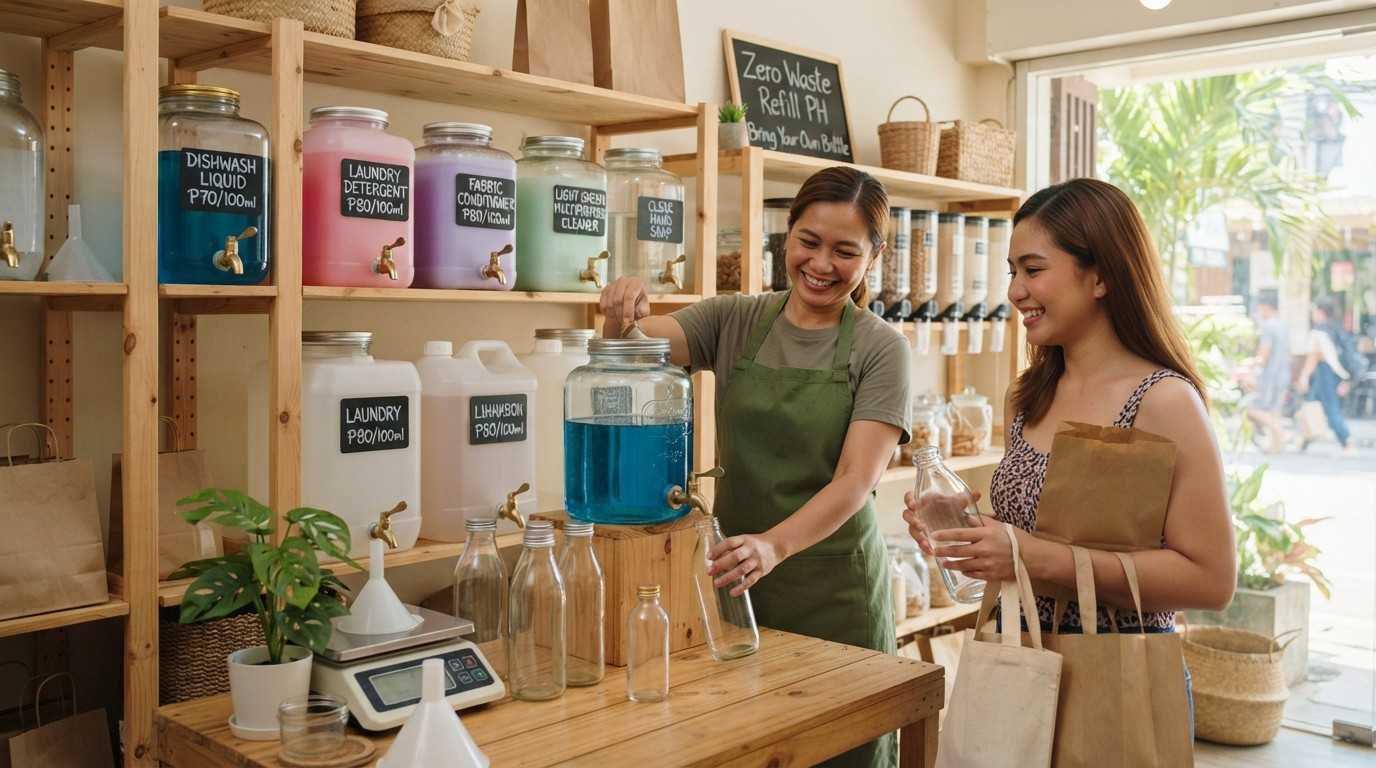
What if you could start a neighborhood business selling everyday household essentials without relying on hundreds of plastic bottles and packaging? A zero-waste refill station offers an interesting business opportunity for aspiring entrepreneurs in the Philippines who want to earn income while promoting more sustainable shopping habits.
The concept is simple: customers bring their own reusable containers and refill them with products such as liquid detergent, dishwashing liquid, shampoo, hand soap, fabric conditioner, and even selected pantry staples. Instead of purchasing a completely new bottle every time, customers pay only for the quantity of product they need.
With household essentials being regular purchases for Filipino families, a conveniently located refill station could become a practical neighborhood business. It can also attract environmentally conscious consumers who want to reduce their plastic waste without spending too much.
1. What Is a Zero-Waste Refill Station?
A zero-waste refill station is a small retail shop or kiosk where customers can purchase liquid and dry products using reusable containers. The business provides dispensing equipment, product storage, weighing scales, and a simple payment system.
For example, a customer who runs out of dishwashing liquid can bring an empty 500 ml bottle to the kiosk. The attendant weighs or measures the container, fills it with the selected product, and charges the customer based on the quantity purchased.
Some refill stations operate as standalone neighborhood stores, while others are incorporated into existing sari-sari stores, grocery shops, and community markets.
The goal is to make everyday shopping more affordable and convenient while reducing unnecessary packaging.
2. Products You Can Sell at Your Refill Station
You do not need to offer dozens of products when starting. Begin with frequently used household essentials and gradually expand based on customer demand.
Household Cleaning Products
- Liquid detergent: A regular household essential used for washing clothes.
- Dishwashing liquid: A frequently purchased product for kitchens and food businesses.
- Fabric conditioner: An additional product that customers can purchase together with laundry detergent.
- Multipurpose cleaner: Useful for cleaning floors, countertops, and other household surfaces.
- Toilet cleaner: A practical addition to your cleaning product selection.
Personal Care Products
- Shampoo: Offer different variants depending on customer preferences.
- Liquid hand soap: Suitable for households, offices, and small establishments.
- Body wash: An alternative to individually packaged personal care products.
- Conditioner: A complementary product that can increase average customer purchases.
Pantry Staples
If you have sufficient space and appropriate food-handling facilities, you can also consider selling selected dry pantry staples.
- Rice
- Sugar
- Salt
- Beans and lentils
- Oats
- Selected dried food products
Food products should have separate dispensing equipment and storage arrangements from cleaning chemicals. Follow applicable food safety, sanitation, and labeling requirements.
3. How to Start a Zero-Waste Refill Station Business
Starting this business does not necessarily require a large commercial space. A small neighborhood kiosk or an existing retail location can be a practical starting point.
Step 1: Research Your Target Market
Before investing in equipment and inventory, identify potential customers in your area. Consider residential communities, subdivisions, apartment complexes, public markets, and neighborhoods with many households.
Find out which household products people regularly purchase, how much they typically spend, and whether they are willing to bring reusable containers when shopping.
You can conduct a simple survey among neighbors or use a Facebook community group to measure interest.
Step 2: Find Reliable Product Suppliers
Look for manufacturers, wholesalers, and distributors that offer household cleaning products in bulk containers. Compare wholesale prices, minimum order quantities, delivery fees, product quality, and available documentation.
For personal care products, make sure the products comply with applicable Philippine Food and Drug Administration (FDA) requirements. Do not simply purchase unverified bulk products and resell them under your own labels.
Choose suppliers that can provide consistent product quality and proper product documentation. This is particularly important when customers will be using these products regularly.
Step 3: Prepare Your Equipment
A small refill station can operate with relatively simple equipment. Your initial setup may include:
- Refill dispensers or liquid storage containers with controlled dispensing systems.
- Digital weighing scales for measuring product quantities.
- Measuring cups and funnels where appropriate.
- Product labels and price displays.
- Storage shelves and cabinets.
- Reusable containers for customers who do not bring their own.
- A cash register or simple point-of-sale system.
Use suitable, clearly labeled containers for each product. Cleaning chemicals and personal care products must be stored and dispensed separately to prevent contamination and accidental mixing.
Step 4: Choose a Convenient Location
Location can significantly influence the success of a neighborhood refill station. Look for areas where customers can easily stop by when buying groceries or other household necessities.
Potential locations include:
- Near residential subdivisions and housing communities.
- Along neighborhood commercial streets.
- Inside or beside an existing sari-sari store.
- Near public markets and grocery stores.
- Close to apartment buildings and boarding houses.
If you already operate a small retail store, adding a refill station could be a way to expand your product offerings without renting another location.
Step 5: Set Competitive Prices
One of the main selling points of refill stations is the opportunity to purchase smaller quantities at an affordable price.
Calculate your selling price based on the wholesale cost, transportation, packaging, operating expenses, and desired profit margin.
For example, you might offer 250 ml, 500 ml, and 1-liter refill options. This allows customers to purchase according to their household budget and actual needs.
Do not compete on price alone. Product quality, cleanliness, accurate measurements, and customer service are equally important.
4. Estimated Startup Capital
The amount needed to start depends on your location, equipment, number of products, and whether you already have an existing store.
Here is an illustrative startup budget for a small neighborhood refill station in the Philippines:
| Startup Requirement | Estimated Cost |
|---|---|
| Initial product inventory | ₱8,000–₱15,000 |
| Refill dispensers and containers | ₱5,000–₱10,000 |
| Digital weighing scales and measuring tools | ₱1,000–₱2,000 |
| Shelves and storage equipment | ₱2,000–₱4,000 |
| Signage, labels, and promotional materials | ₱1,000–₱2,000 |
| Miscellaneous expenses | ₱2,000–₱3,000 |
| Total Estimated Capital | ₱19,000–₱36,000 |
Note: These are illustrative planning estimates, not verified supplier quotations. Actual costs may be higher depending on equipment quality, location, rental deposits, permits, and inventory requirements. A rented commercial space may require additional capital.
5. How Much Can You Earn?
Your potential earnings will depend on daily sales, product costs, operating expenses, and customer retention.
Consider this simplified example:
- Average daily sales: ₱1,500
- Operating days per month: 26 days
- Estimated monthly sales: ₱39,000
- Illustrative gross margin: 30%
- Estimated gross profit: ₱11,700
From the estimated gross profit, you still need to deduct rent, electricity, transportation, labor, supplies, and other operating expenses.
This means the actual net income could be significantly lower. However, if you operate from an existing store and keep overhead expenses manageable, the business may become a useful additional source of income.
As your customer base grows, you can introduce more products, offer household refill packages, and provide bulk orders for small businesses.
6. Marketing Strategies to Attract Customers
Since a refill station is a neighborhood-based business, building customer awareness and encouraging repeat purchases should be your priorities.
- Offer opening promotions: Give introductory discounts to encourage first-time customers.
- Promote container reuse: Encourage customers to bring clean, suitable containers when shopping.
- Use Facebook: Post product prices, available refill sizes, promotions, and store updates in local community groups.
- Create loyalty rewards: Give regular customers discounts or rewards after reaching a certain purchase amount.
- Offer household bundles: Create packages combining detergent, dishwashing liquid, and fabric conditioner.
- Partner with small businesses: Approach laundry shops, cleaning service providers, and other establishments that regularly use cleaning products.
You can also offer scheduled neighborhood delivery for customers who purchase larger quantities. This provides additional convenience and creates another potential revenue stream.
7. Business Registration and Important Requirements
Before opening your refill station, make sure your business complies with applicable Philippine regulations.
Depending on your business structure and products, you may need to consider:
- Business name registration with the Department of Trade and Industry (DTI) for a sole proprietorship, or registration with the Securities and Exchange Commission (SEC) for a corporation or partnership.
- Barangay clearance and the appropriate business permit from your local government unit (LGU).
- Registration with the Bureau of Internal Revenue (BIR).
- Applicable product registration, notification, labeling, and other FDA requirements for regulated personal care and household products.
- Applicable environmental, sanitation, fire safety, and consumer protection requirements.
Requirements can vary depending on the products you sell and how they are sourced, repackaged, or distributed. Check with your LGU and the relevant government agencies before starting operations.
8. Challenges to Consider
Although the refill station concept offers business opportunities, it also comes with challenges that entrepreneurs should understand.
Customer habits: Some consumers are accustomed to buying branded products in sealed bottles. You need to build trust and demonstrate the quality and value of your offerings.
Product quality: Inconsistent product quality can damage your reputation. Work with reliable suppliers and maintain proper product handling procedures.
Inventory management: Products have different sales rates and shelf-life considerations. Monitor inventory regularly to avoid overstocking and product waste.
Competition: Supermarkets, convenience stores, and online sellers already offer household essentials. Your advantage should be convenience, flexible quantities, competitive pricing, and reliable service.
Compliance and safety: Proper labeling, storage, dispensing, and sanitation are essential. Never mix products or transfer them into containers that are unsuitable for their intended use.
Is a Zero-Waste Refill Station Worth Starting?
A zero-waste refill station can be a practical small business opportunity for Filipinos who want to enter the retail industry with a manageable starting setup. It serves a basic and recurring consumer need while introducing a different way of purchasing household essentials.
The best approach is to start small. Focus on a few fast-moving products, find trustworthy suppliers, and establish your business in a location where households can easily access your services.
You do not need to open a large eco-friendly store immediately. Even a small kiosk in a residential neighborhood or an additional service inside an existing sari-sari store could be a starting point.
Ultimately, the success of this business will depend on offering quality products, fair prices, convenient service, and a shopping experience that encourages customers to return.
For aspiring entrepreneurs, a zero-waste refill station is an opportunity to build a business around something people already need every day while helping reduce unnecessary packaging.

Business News Philippines was launched in October 2015 as a portal for readers to learn more about operating a business in the Philippines.
