


This article was produced for ProPublica’s Local Reporting Network in partnership with the Anchorage Daily News. Sign up for Dispatches to get our stories in your inbox every week.
Leaders in Alaska and elsewhere have repeatedly promised action in recent years to address the nation’s chronic failure to solve the murder or disappearance of Indigenous people.
Federal legislation backed by Alaska Sen. Lisa Murkowski called for improving data collection and information sharing among law enforcement and tribes. Gov. Mike Dunleavy said again and again and as recently as May 5 that the state government would work with Alaska Natives to address the crisis.
“My administration will continue to support law enforcement, victim advocacy groups, Alaska Native Tribes and other entities working together to solve these cases and bring closure to victims’ families,” Dunleavy said in a news release last year.
Yet when an Alaska Native group asked state law enforcement officials in June for one of the most fundamental pieces of data needed to understand the issue — a list of murders investigated by state police — the state said no.
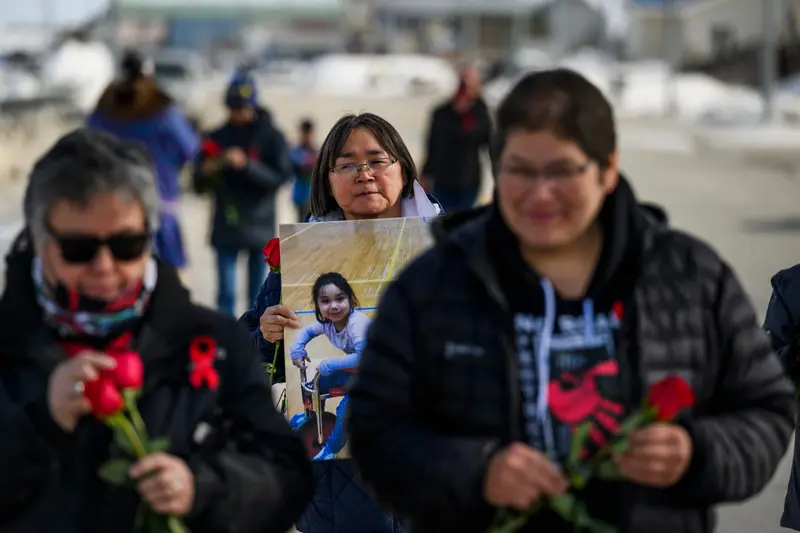
Charlene Aqpik Apok launched Data for Indigenous Justice in 2020 after trying to collect the names of missing and murdered Indigenous people to read at a rally, only to discover no government agency had been keeping track. Over time, the nonprofit built its own homegrown database with the help of villagers, friends and family across the state.
In 2023, the state started publishing a list quarterly with names of Indigenous people reported missing. But the state still does not issue a list for the other key piece of the group’s efforts: Indigenous people who have been killed.
So on June 4, the nonprofit filed two public records requests with the Alaska Department of Public Safety concerning homicide cases the agency had investigated since 2022. The group asked first for victims of all races and then for those identified as Alaska Native.
Apok said she didn’t think the request was controversial or complicated.
But the state rejected the requests a week later. The agency said fulfilling the request would take “several hours” and cited a state regulation allowing a denial if providing information to a requester would require employees to “compile or summarize” existing public records.
“We do not keep lists of victims of any type of crime, including homicide victims, and to fulfil this request DPS would have to manually review incident reports from multiple years to create a record that matched what you are looking for,” Austin McDaniel, communications director for the department, wrote to the nonprofit.
McDaniel offered no direct response when the Anchorage Daily News and ProPublica asked why the agency could not retrieve homicide records with a simple database query or why, even if the work required manual review and wasn’t required under state law, the agency didn’t simply create a list of homicide victims.
(Alaska’s public records law says any records that take state employees fewer than five hours to produce shall be provided for free, and the state can choose to waive research fees if providing records would serve the public interest. Even if an agency needs to create a new record, as McDaniel asserted in his denial, it’s allowed to “if the public agency can do so without impairing its functioning.”)
Data for Indigenous Justice appealed the denial to the head of the department, Public Safety Commissioner James Cockrell, who decided in favor of the agency.
The nonprofit’s records request and the state’s denial revealed that Alaska, four years after creating a council on murdered and missing Indigenous people, cannot readily identify murder cases involving Indigenous victims. The state now employs four investigators who focus on such cases.
“How do they know which cases are Alaska Native or Indigenous people for their MMIP investigators if they cannot do a simple pull of the demographics that we are talking about?” Apok said.
Apok said tracking complete and accurate data on Indigenous people who have disappeared or been killed matters because otherwise, law enforcement can shrug off individual cases and deny the scale of the problem.
“That’s the power of data. That’s the power of collective information,” she said.
Credit:
Marc Lester/ADN
In lieu of answering detailed questions for this story, McDaniel provided a one-page response saying that the department receives thousands of records requests each year. He said the agency is a “leader in data transparency” for missing and murdered Indigenous people, adding that “to imply that we are not invested in this work due to the denial of one records request from an advocacy group is absurd.”
He cited as examples of transparency the department’s publication of information about missing Indigenous people and its provision of law enforcement data to tribal governments in support of their requests for federal grants.
Anchorage, which runs the state’s largest municipal police department, recently reversed a policy that withheld the identities of certain homicide victims. The police chief released the records after Daily News reporting revealed the policy had no basis in law and was opposed by some victims’ rights advocates.
State troopers, meanwhile, handle about 38% of all murders in Alaska, according to statistics that law enforcement reports each year. From 2019 to 2023, the most recent data available, troopers investigated an average of 22 murders each year. That means the agency would likely need to review just a few dozen reports to provide the requested names.
Watershed reports published in Canada in 2017 and by the Seattle-based Urban Indian Health Institute in 2018 revealed the scope of the crisis of missing and murdered people from Indigenous communities.
Those reports, Apok said, “named exactly what a lot of us were seeing and feeling, where we didn’t know our experiences were part of a larger collective.”
In 2021, Data for Indigenous Justice published the first report on the crisis in Alaska, highlighting the failure of media and local governments to gather data on cases of missing and murdered people to analyze patterns. A council appointed by Dunleavy even relied on Apok’s findings — including her conclusion that little data is available — when trying to describe the scope of the problem.
Dunleavy and Murkowski have been vocal on the issue in the years since.
A spokesperson for the governor did not respond to emailed and hand-delivered questions about the state’s failure to provide names of homicide victims to Apok’s group. Told of the decision not to release the names, Murkowski’s office said the senator was unavailable for an interview and offered no comment on the state’s actions.
Apok said her group will continue making public records requests to the state while building its own database through community connections.
“We’re going to keep doing what we do,” she said. “People will keep telling us names.”
