

For about a year, Austin Davis’ phone has been flooded with hundreds of pleas for help from across the Phoenix metropolitan area.
A school employee wanted to help a homeless family but couldn’t find space at a shelter. Could Davis pay for a hotel room?
A mother of five living in a storage unit contacted a homeless services organization for help. They told her to call Davis.
A mother panhandling with her six children said passersby gave her Davis’ phone number, telling her he might be able to provide shelter. “I feel like the worst mother in the world,” she texted him.
Nearly every person who’s reached out to Davis, a 26-year-old poet and advocate for homeless people, says they’d first called 211, seeking help through the official channel, only to learn it could be months before they’d get shelter or a housing placement. His phone has become the unofficial hotline for emergency shelter.
Caseworkers, teachers, social workers, police and hospital workers have called and texted to see if Davis can help people without a place to go. Even workers from the official channel — 211 and the Family Housing Hub — have sent people to him.
Davis’ path to becoming the de facto advocate of last resort illustrates how the system set up to care for families who are homeless in Maricopa County is failing them. ProPublica found that calling and visiting the official channel to address family homelessness rarely leads to offers of help, leaving families feeling hopeless.


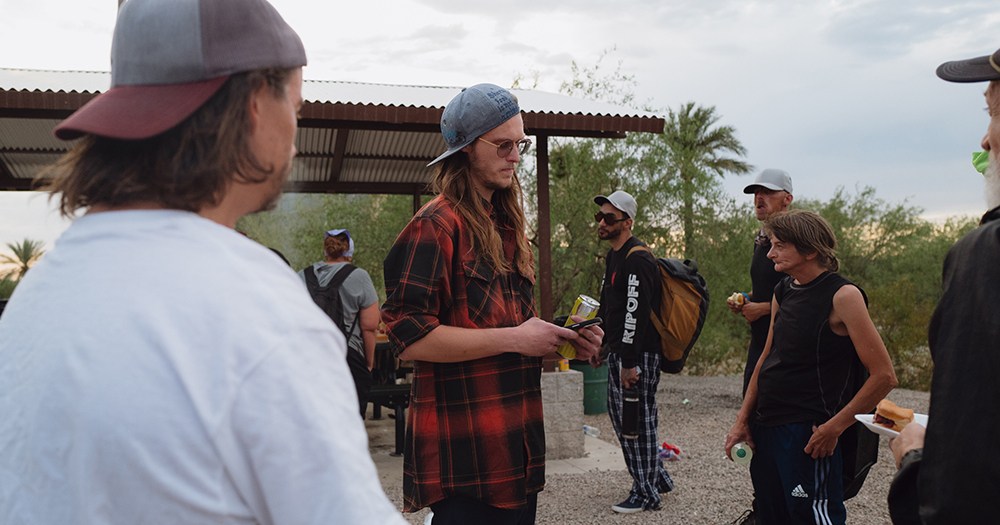
In January, I started coming to Tempe’s Moeur Park, known as “The Hill,” to meet the families Davis was assisting. I was struck by the scene of desperate parents, some of whom had recently been evicted, lost a job or fled domestic violence, surrounding Davis to tell him about their situation. As he listened, he played with their children, always with an energy drink in hand.
The scene was both heartening and disconcerting. Davis was helping families stay off the street, which was good. But why, I wondered, in a county of nearly 5 million people, was a man in a park their best chance at getting help? And why were government agencies and multimillion-dollar nonprofits, some tasked with helping the very same homeless families, sending people to him?
Davis, who runs a small nonprofit called AZ Hugs, is known for working outside the system. With the help of volunteers, he hosts a nightly meal for homeless people at a suburban Phoenix park. This has drawn the ire of Tempe officials and led to 35 citations against him for trespassing and holding picnics without permits. (In 2024, he reached a deal to plead guilty to one permit violation, and the city dismissed the other citations, according to court documents. He’s spent three nights in jail.) In 2025, Davis and two other advocates for homeless people filed a lawsuit against Tempe, alleging it had violated their free speech protections by citing them for feeding people in parks. The city revised its permit ordinance, and Davis withdrew the lawsuit.
In recent months, he has tried to draw attention to what he calls the “family homelessness crisis,” raising money on social media to pay for hotel rooms for families, many with young children, who would otherwise sleep on the street or in their cars. Davis said he cannot assist everyone who asks for help. A much bigger effort is needed, he added, involving nonprofits and local and state officials, but he sees little evidence that it’s happening.
The number of people in homeless families in Maricopa County reached 2,103 this year, its highest level since 2015, according to the latest figures that are compiled locally and reported to the federal government. And those numbers are considered an undercount because the tally is taken on a single night by volunteers who can miss people who are trying to stay out of sight. In late September, nearly 200 families were on the waitlist for shelter in the county. It doesn’t include those who couldn’t get on; were kicked off because they weren’t considered homeless; or those who called 211, found it unhelpful and never called back. (Solari, a nonprofit that runs the statewide 211 line, said that the Family Housing Hub, which is run by UMOM, a nonprofit, sets the eligibility criteria for placement on the shelter waitlist.)
I spoke to more than 30 families searching for shelter. Parents told me they worried how their situation was affecting their children. Research shows homelessness harms children, disrupting brain development and growth and leading to permanent changes in the brain and body.

Candice Ortiz had tried since spring to find stable shelter and housing. As the months dragged on, she noticed the toll on her 8-year-old son. He was hospitalized for heat exhaustion after spending the day outside, and she worried about the school he missed.
Davis helped Ortiz as she hit dead ends in her search for a place to stay, according to text messages reviewed by ProPublica.
She said she had called 211 over and over, answering the same questions about her living situation, only to receive information she could have found through a simple internet search. She said a worker with the Family Housing Hub told her that since she and her children were sleeping in her car, she wasn’t actually homeless. Another told her the waitlist was full.
In June, she spent the day at a Phoenix cooling center to escape the heat. A representative told her to go to UMOM, which runs an emergency shelter for families. She said she used her last $20 on a rideshare to the shelter. They took her information again and told her she wasn’t “in the system.” Nothing was available. UMOM said to protect the privacy of clients, it does not comment on individual families.
At the end of August, she connected with the Phoenix Rescue Mission, a nonprofit that offers programs for homeless people. The group sent Ortiz to a local apartment complex where she viewed an apartment. Later, a worker with the Phoenix Rescue Mission told her that it ran out of funding to pay for it, text messages reviewed by ProPublica show. Phoenix Rescue Mission did not respond to requests for comment.
UMOM, which during the last fiscal year received more than $7 million in government grants, set aside 23 units of shelter and about a dozen tents for families this summer, as temperatures reached 117 degrees. The program, which is part of the city of Phoenix’s heat relief effort, has helped nearly 300 households so far but is winding down this month.
In early April, Davis had tried to force a broader effort to address the crisis by launching an online petition. It called on Arizona Gov. Katie Hobbs, a Democrat, to declare a state of emergency to address family homelessness. The petition has more than 5,000 signatures.
In June, a volunteer with Davis’ organization attended a fundraiser for Hobbs, who is running for reelection, to hand her a letter about the petition. The letter suggested such a declaration could unlock funding for emergency shelter and recommended making it easier to access the Family Housing Hub.
“I implore you to consider the children who endure extreme heat without safe shelter,” the letter stated. “No parent should be told to wait months for assistance while temperatures reach life-threatening levels.”

Davis told me he hasn’t heard from the governor’s office or from other nonprofit leaders about joining his effort — only from caseworkers hoping he might help them find shelter for families. He wished that other organizations would at least acknowledge the problem and called their silence “frustrating” and a “disservice” to those in crisis.
The governor’s press secretary, Liliana Soto, told me emergency declarations are reserved for natural disasters, and using one to address homelessness might not be appropriate. Soto added that the governor is “deeply aware” of these challenges. Since taking office in 2023, Hobbs has allocated at least $245 million statewide on efforts such as eviction prevention, affordable housing, emergency shelter and rapidly rehousing people experiencing housing insecurity. “The governor believes no family, especially families with infants or young children, should be left without a safe place to go during the summer heat,” Soto said in a statement.
Davis sees families in that situation daily. And he spends most nights pleading for money on social media to put them in hotel rooms. Some nights he has raised thousands of dollars, posting updates at 2 a.m.
In September, Davis’ organization started hosting an overnight shelter at the First United Methodist Church of Mesa. It has space for at least six families. Davis said he knows it’s a Band-Aid on a much bigger problem.
At the church on a recent evening, some families arrived in vehicles packed with their belongings. Inside a large air-conditioned room, a volunteer had set up canopy tents with cots, pillows and blankets. She offered them a dinner of chicken penne pasta.
A mother and her two children showered, then got in their tent and zipped it up. Gradually, others, some with toddlers, settled in, and the room became quiet.
They’d need to be gone by 6 a.m.

