

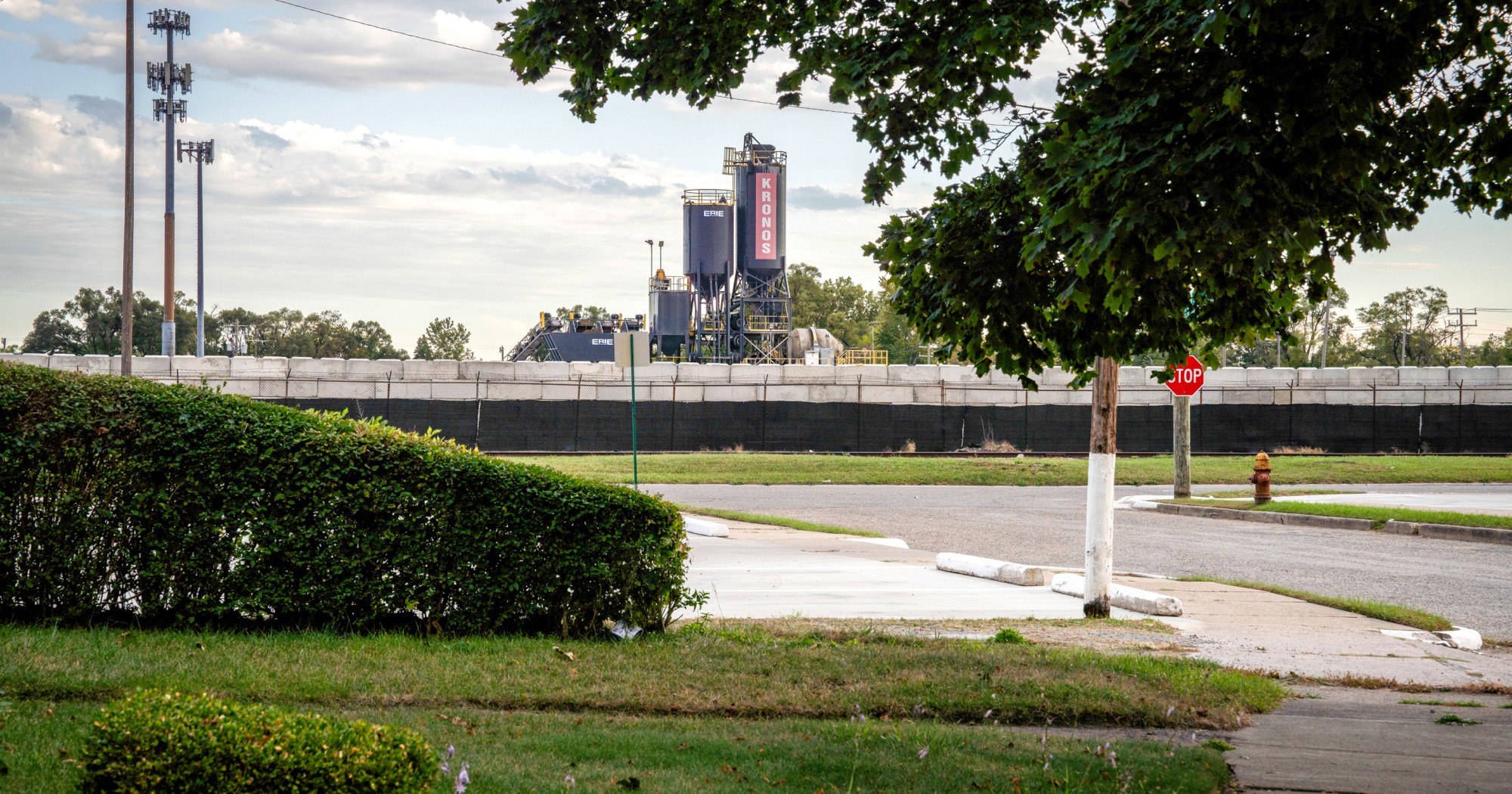
After years of community opposition, Detroit city officials have taken steps to stop a concrete mixing facility from further expanding into a residential neighborhood.
City Council members, acting on a recommendation last week from planning officials, will soon consider a rezoning measure that would restrict industrial activity at the site of the Kronos concrete plant and surrounding area. The concrete facility at its current size could stay and continue to operate as normal.
The planning recommendation comes after a BridgeDetroit and ProPublica investigation this year revealed how city officials helped Crown Enterprises, a real estate company owned by Detroit’s wealthy Moroun family, obtain property in Cadillac Heights and then provided latitude when its Kronos facility violated environmental laws. Residents have been filing complaints and protesting Kronos for years, frustrated by the dust, noise and other issues created by the concrete operation.
The City Planning Commission voted Oct. 22 to recommend a change to some of the zoning in the neighborhood from heavy to light industrial, which allows buildings such as warehouses but excludes facilities like concrete plants. The commission also recommended that other lots be zoned for residential and commercial purposes. Earlier this month, the commissioners unanimously voted to exclude industrial zoning in the area adjacent to Kronos, but they stepped back from that last week.
Crown has objected to any zoning change.
Sharon Buttry, who helped organize residents to protest against the Kronos plant, said she is glad the lots would be rezoned but was disappointed that the earlier recommendation, which was more pedestrian- and transit-friendly, didn’t stand.
Buttry said she fears that the latest zoning recommendation would make it easier for Crown to expand eventually. “We still want them to shut down or move,” she said.
The zoning plan was revisited at the request of City Planning Commissioner Fred Russell Jr., who said the adjustment would create a buffer between residents and the existing concrete plant.
The City Council, which will ultimately decide on the rezoning, has scheduled a public hearing for Nov. 19.
Over the last seven years, Crown has obtained dozens of parcels in Cadillac Heights — some through a land deal with the city in 2019 and others after residents sold their parcels and left. In all, the company now owns more than 160 lots in the neighborhood, most of which are barren.
How a 2019 Land-Swap Deal Accelerated the Morouns’ Foothold
The Moroun family spent decades, from 1966 to 2018, records show, gradually acquiring lots in Cadillac Heights through their various companies, eventually putting the parcels all under the ownership of Crown Enterprises. A May 2019 deal with the city of Detroit allowed Crown to acquire dozens of additional parcels during the next seven years.

Properties owned by the Moroun family
before May 2019
Site of
Kronos Concrete
plant
Properties the Moroun family owned,
titled under Crown Enterprises, as of June
Site of
Kronos Concrete
plant

Properties owned by the Moroun family before May 2019
Site of
Kronos
Concrete
plant
Properties the Moroun family owned, titled under Crown
Enterprises, as of June
Site of
Kronos
Concrete
plant

Properties owned by the Moroun family before May 2019
Site of
Kronos
Concrete
plant
Properties the Moroun family owned, titled under Crown Enterprises,
as of June
Site of Kronos Concrete
plant
Chris Alcantara/ProPublica
In a letter to Detroit officials in mid-September and Oct. 22, a law firm representing Crown threatened legal action if city officials change the zoning, arguing that doing so would devalue the property and create uncertainty about future development.
Attorney Melvin Butch Hollowell also said if the rezoning goes through, the city would be backtracking on its commitment to support Crown’s development in Cadillac Heights. Crown obtained the land there in exchange for the company swapping property in another part of the city, which allowed automaker Stellantis to open the first new car plant in Detroit in three decades.
City officials have said they didn’t know Crown’s plans included a concrete facility. Crown did not present a specific plan at the time of the land transfer. But after the concrete plant opened, the city in 2022 signed a first-of-its-kind agreement with Crown that gave the company time to fix issues before being penalized. The agreement has allowed the company to avoid fines on several occasions, the news organizations have documented.
In response to questions from BridgeDetroit and ProPublica, a Crown spokesperson said the company has invested more than $10 million to develop the concrete operation based “on the City’s promises and actions of approving our plans for this facility.”
“The property was traded to us for the express purpose of redevelopment,” the spokesperson, Kenneth Dobson, wrote.
Dobson said that if the zoning changes, the company will not make the improvements it has promised, including new landscaping and sidewalks. He claimed the improvements would not be allowed under the new zoning and that they also wouldn’t be a sound business decision. City planning staff, however, said the company can still make the improvements.
The neighborhood surrounding Kronos has been zoned to allow heavy industry since the 1940s, when a rail line operated there. Before the concrete operation, the land was occupied by a trucking depot for decades.
Despite the zoning designation, the neighborhood attracted working-class families who lived in modest single-family houses. Buddy’s Pizza, famous as the birthplace of Detroit-style pizza, was founded there and drew crowds from across the city.
The City Planning Commission’s votes this month were four years in the making and part of a broader evaluation of land near the proposed Joe Louis Greenway, a walking and biking trail that will traverse the city and is already under construction.
Scott Benson, the council member who represents Cadillac Heights, asked the planning commission in 2023 to consider whether the industrial zoned areas along the greenway should be rezoned to a use that better supports safety and public health. He said the request at first was unrelated to Kronos, but then community input further influenced the desire for change.
“That did play a role here,” he said in an interview. “The community came out and said, ‘Yes, we especially want this part done and it abuts the Joe Louis Greenway.’”

More than 30 people — some in favor of a zoning change and some against — spoke out at recent commission meetings. Kronos employees and others told the commission that the company has created jobs for Detroit residents and said Crown has invested in the neighborhood with new paving.
Terrell Daniel, whom the city identified in meeting minutes as a Kronos employee, urged the commission at its Oct. 1 meeting to continue to allow industry in the neighborhood.
“It’s bringing back the backbone of Detroit,” he said. He said the concrete plant has provided an opportunity “for guys who never had a chance to work in the city.”
Those in support of rezoning expressed concerns about the dust, air quality and Crown’s track record of not taking care of the neighborhood, which has included leaving vacant homes unsecured and messy.

Residents have filed about 80 complaints to both city and state environmental offices, according to records obtained by BridgeDetroit and ProPublica. They have described “literal whiteout conditions” and “dust clouds” that blanket their neighborhood and irritate their eyes.
The city has issued several tickets to Kronos for violating Detroit’s fugitive dust ordinance, passed in 2024 to limit pollution. The law requires businesses such as concrete plants and scrapyards to submit plans to limit dust and prevent it from spreading into neighborhoods.
On Oct. 7, the city received a complaint about Kronos and an inspector found the company had spread dust in the neighborhood and had piles of materials that should have been blocked from view, according to city spokesperson Georgette Johnson.
Kronos wrote in a letter to the city that it swept and watered the streets and reduced the height of the piles. Johnson said Crown corrected the problems.
Dobson said readings from its air monitors have never exceeded the city’s pollution limits and that a small number of people regularly complain. He previously said that the company planned to demolish a vacant home littered with trash but was waiting on utilities to be disconnected.
