

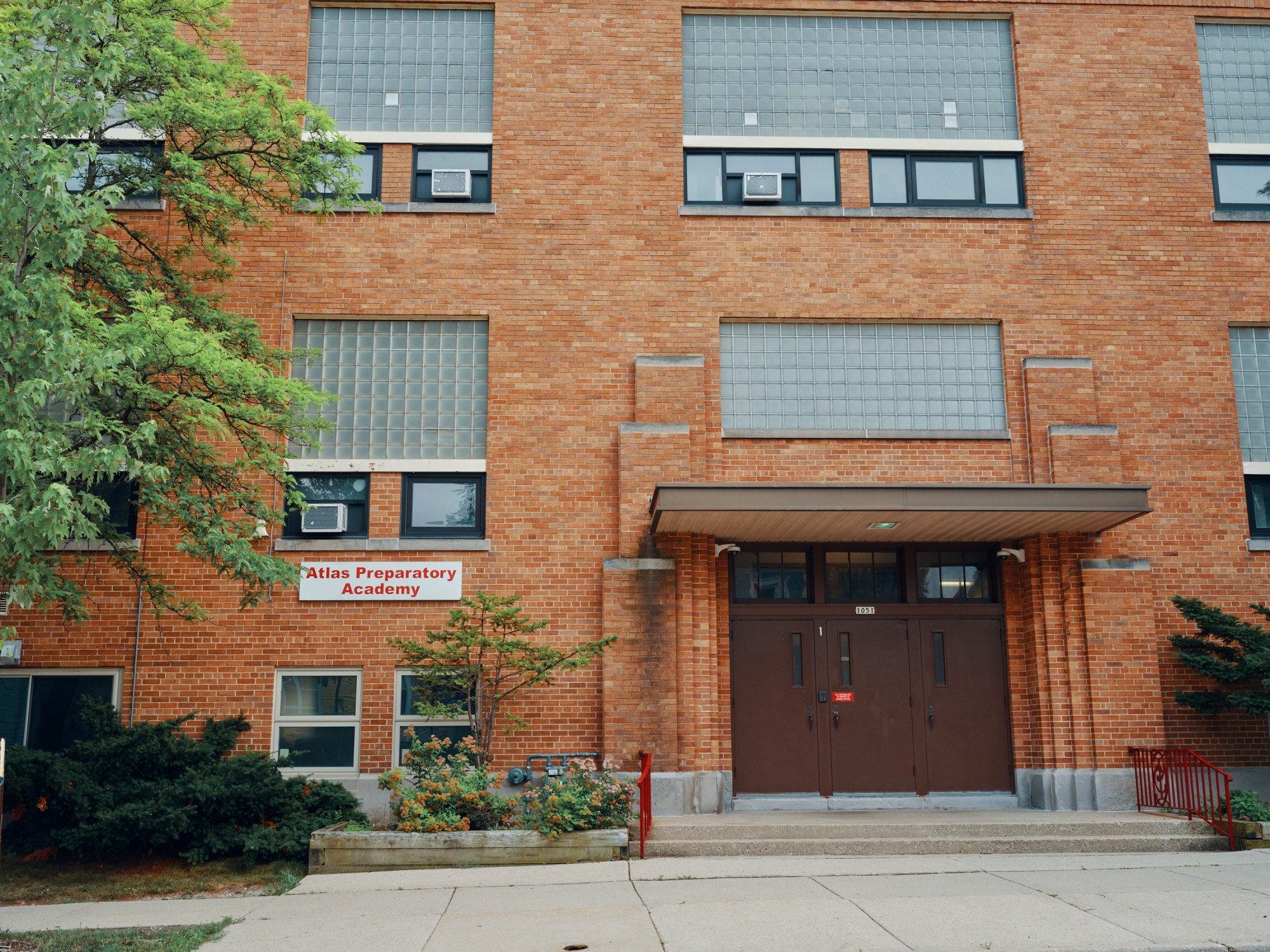
At some point, my reporting colleagues and I began referring to them as the “100% schools.”
We were following the money that flows from states’ public coffers into private schools through vouchers when we noticed a subset of educational facilities where tax dollars cover all or a big part of the tuition for every student.
In essence, these were schools that were funded like public schools but didn’t operate with the same oversight or transparency.
Our reporting found that these types of private schools exist throughout the country and that in Wisconsin — where I’m based — there were 39 that fell into that category during the most recent school year. Together, they were educating 7,923 children and taking in roughly $87 million from vouchers offered by the state.
Atlas Preparatory Academy in Milwaukee was a 100% school in my city that had low test scores and declining enrollment while also receiving more than $4.3 million in voucher money for 357 students in grades K-12. It was one of the first schools I dug into, and immediately some of the facts I unearthed in public documents made me curious.
There was, for instance, the money being made by its board chair, who also appeared to serve as a school administrator. His compensation was more than $150,000 in 2024.
This dual role would be prohibited at a traditional public school in Wisconsin, though there are no such rules for private schools.
In another transaction that would raise alarm in a public school setting, the same board chair’s accounting firm received tens of thousands of dollars from the school for accounting and consulting.
During my reporting, it became clear that the school’s operations were not only discordant with public school policies but with basic governing standards for nonprofits, experts told me.
More than a decade ago, a Wisconsin Department of Public Instruction research paper on what it called “choice schools” asked: “When is a private school really a public school?”
Though that question still resonates today, public officials supporting vouchers have yet to provide a clear answer.
Have you had trouble finding a school or using a voucher-style program? Do you have concerns about schools — public or private — in your area? Help us understand how families across the country are navigating their school options.
Nor has there been any progress in Wisconsin or elsewhere in lining up the standards of private and public schools on a range of issues, even with the spectacular growth of private schools funded by taxpayer dollars.
Voucher schools, for instance, are not required to serve all children with disabilities. Public schools are.
Another major difference is transparency. In Wisconsin and elsewhere, information about public schools — good, bad or mundane — can be gleaned through open meetings, district YouTube channels and robust websites with detailed agendas, minutes, reports, statistics and information about enrollment, curriculum, special education services and more.
Districts have to abide by Wisconsin’s open records law, meaning that reams of records are available to anyone who formally requests them. Not so for the private schools. Voucher schools must, by law, have at least two opportunities a year for parents to meet with the governing board. But the schools do not have to make those meetings accessible to the general public.
In many states, private schools also don’t have to administer standardized tests or report those scores — in sharp contrast to the mandates for public schools. Wisconsin is different because it does require both students using vouchers and public school students to be tested, though parents can and do opt out.
In recent years, Atlas Prep has fared poorly on the state’s report card for schools, garnering the lowest rating: “fails to meet expectations,” or one star out of a possible five.
Not far from Atlas, Bay View High School, a public school, also has earned only one star on the state report card. Its website connects the public to the school’s improvement plan — its strategy to reduce dropouts and improve school culture — as well as information about local school council meetings and discipline methods, and about its science, technology, engineering, arts and math programming.
The Atlas Prep website includes a tab labeled “Build Your Own Curriculum.” When you click on it, nothing loads.
Though every student at the 100% schools we looked at relies on public funds for tuition, the money does not necessarily make up the institution’s total budget. The schools can take in additional revenue from investments, fundraising, grants or other means, but they are heavily dependent on tax dollars to maintain operations.
“If the choice schools are really some kind of quasi-public schools, then in keeping with national efforts to turnaround struggling schools, it may be necessary to subject low-performing choice schools to financial sanctions, turnaround efforts or even closure,” the state Department of Public Instruction suggested in its research paper.
That was back in 2011. Those types of accountability measures still do not exist.
Some key financial documents are available, however, for Wisconsin voucher schools — if you know where to look.
Annual IRS information filings for many nonprofit schools are easily obtainable through ProPublica’s Nonprofit Explorer page. And independent financial audits, required by the state, are available through the state Department of Public Instruction. I requested those for a handful of Wisconsin’s 100% schools, and I visited four.
One warm day in June, I stood in the lobby of one such school in Milwaukee, near a large fish tank. I’d sought days earlier to contact the woman running the school. An audit showed she was paying her own company rent for the building ($128,000 in one recent year). She put me off. “I’m not interested, ma’am,” she said via a phone in the foyer. “Please do not call us back again.”
On the other side of town, I rang the bell at Atlas Prep’s high school building and asked to speak to the executive director, Michelle Lukacs. I was informed she was headed to a meeting and could not speak with me.
By then, I was digging into Atlas’ finances, a process that would last several weeks and continue into July.
Over multiple emails, I shared with Lukacs what I was learning, including the compensation of the board chair, Steven E. Menden. A licensed certified public accountant, Menden had compiled the school’s IRS filing since its formation in 2001.
At times since then, Menden has been listed on the school’s website as “board advisor.” His daughter, Kaitlyn Menden, was also among the school’s most highly compensated employees in 2024. Her package was $127,674 in salary and benefits for a job in “business services.” (In an email to me, she described her role as wearing “many hats” beyond that, citing human resources duties, “oversight of the school’s technology hardware and cloud resources” and “special projects.”)
In the past couple of years, records show, Steven Menden has taken on the role of board chairman. The fiscal year 2025 IRS form showed Menden putting in a 40-hour workweek for Atlas and earning $132,505 in pay plus $19,916 in additional benefits. What’s more, his accounting firm, Menden & Associates, had an $87,250 contract.
Lukacs defended the school’s compensation practices, noting in an email: “Every person on our team, regardless of their role, earns their compensation and is not overpaid.”
She explained that Menden is not compensated for his board service but for “Executive Management Services.”
It would be forbidden for a public school board member in Wisconsin to also have a district management job under a legal doctrine regarding roles that are “incompatible.”
“In essence, one cannot supervise oneself, which would include hiring and firing and disciplining oneself,” said Dan Rossmiller, executive director of the Wisconsin Association of School Boards.
State law governing public officials also prohibits school board members from having a private interest in any contract over $15,000 that they bid for, vote on, negotiate or participate in. Violators can be charged with a low-level felony. There is no similar law that pertains to private school operators in Wisconsin.
In an email to me, Menden explained how the Atlas board handles potential conflicts of interest.
“Any conflicts of interest for either related or unrelated parties are resolved in favor of Atlas Preparatory Academy as outlined in our IRS mandated Conflict of Interest Policy,” he wrote. “This means that conflicted persons recuse themselves from the situation and do not vote or participate and the final decision that is made is strictly in the best financial interest of the school.”
This organizational structure does not comport with best practices for the governance of a nonprofit organization, experts told me.
“Board members are volunteers, and best practice is unambiguous that they should not simultaneously hold paid staff positions at the school they oversee — doing so collapses the separation between governance and management that gives a board its purpose in the first place,” said Chelsea Cross, a vice president at City Forward Collective in Milwaukee.
City Forward is a nonprofit group that champions high-quality school options for students and has been critical of the performance of the Milwaukee Public Schools.
Atlas Prep’s IRS filing indicated that Lukacs, the full-time executive director, earned $175,000 in salary and benefits and also had a board position. A third board member is listed as working only one hour a week for no pay.
In a public school setting, Lukacs’ situation would be akin to a district superintendent also sitting on the school board — an arrangement that would raise issues over proper checks and balances since superintendents typically are hired by and report to the school board.
Said Cross: “With 2/3 of its governing board also on the payroll — including the very executive the board exists to evaluate — Atlas Prep’s board cannot meaningfully hold its own leadership accountable.”
Lukacs disagreed with that assessment. “This is a false statement,” she wrote in an email, saying that Atlas board members “model strong personal leadership showing integrity, confidence and consistency in their actions and decision making.”
She told me she does not vote to approve her own salary “or vote in any other situation where a conflict of interest exists.” And she noted that countless hours have been invested at Atlas Prep in improving curriculum and student support. “While our standardized test scores do not yet reflect the level of achievement we aspire to, our staff has remained steadfast in its commitment to continuous improvement,” she wrote.
I had asked Atlas Prep twice for a copy of the school’s conflict of interest policy, which Menden had mentioned. As of mid-August, I had not received it.
I also requested a copy of the school’s contract with Menden’s accounting firm. I did not receive that either.
At a public school, such contracts would be subject to open record laws. I easily found a link on the Milwaukee Public Schools website to a decade’s worth of contracts for school nurses, mental health services, fitness instructors, interpreters, color printers, portable toilets, busing, professional development and so on.
But Atlas does not post those records online. It doesn’t have to.

