


By Pexcel John Bacon
THE PHILIPPINES’ proposed 2027 national budget puts social services and infrastructure at the center of government spending, with education, public works and health among the biggest beneficiaries as President Ferdinand R. Marcos, Jr. enters the final stretch of his term.
The Department of Budget and Management’s P7.2-trillion ($118 billion) National Expenditure Program submitted to the House of Representatives on Tuesday allocates P2.46 trillion, or 34.1% of the proposed spending plan, to social services. Economic services receive P1.83 trillion or 25.5%, while general public services are allocated P1.32 trillion or 18.3%.
Defense will get P452.4 billion or 6.3%, while the debt burden is allotted P1.14 trillion or 15.9%. Next year’s proposed spending plan is 6% higher than this year and is 21.7% of economic output.
“This budget prioritizes the provision of support for our country’s economic growth through strategic investments in infrastructure, education, health, food security and social protection,” Budget Secretary Kim Robert C. de Leon said during the budget plan turnover ceremony.
He said these priorities are essential to improving public services and ensuring that government resources respond to the needs of the people.
The proposed budget will now undergo congressional scrutiny and deliberations before it is enacted into law.
For the Marcos administration, the spending priorities offer a measure of where public resources are being directed during the remaining years of its term, particularly toward education, infrastructure, healthcare, social protection and economic development.
Mr. Marcos said the national budget is designed to sustain economic growth while keeping the government’s fiscal consolidation efforts on track.
“Throughout the budget preparation process, I directed all agencies to focus on measurable outcomes, align their proposals with our development agenda, eliminate unnecessary or inefficient expenditures and ensure that every peso produces meaningful and lasting value,” he said in his budget message to Congress.
The spending mix highlights the government’s continued emphasis on basic services and economic infrastructure, even as it sets aside significant resources for defense and other public sector functions.
‘ANCHORED ON FISCAL DISCIPLINE’
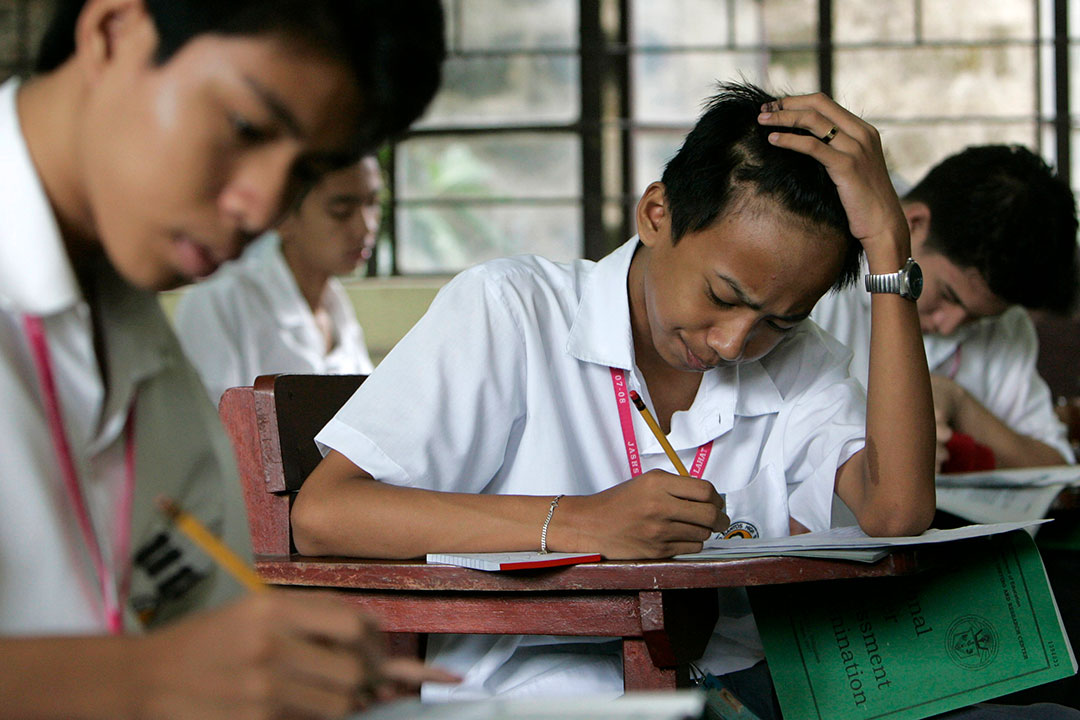
The Department of Education is earmarked to receive P976 billion, the biggest allocation among government departments. The Department of Public Works and Highways follows with P644 billion, while the Department of Health is allotted P353.8 billion.
The education allocation includes P61.1 billion for universal access to quality tertiary education, P38.1 billion for government assistance and subsidies, P30.6 billion for basic education facilities and P12.1 billion for an expanded career progression system.
Infrastructure spending also remains substantial. The proposed budget includes P195 billion for the railway transport program, P176.6 billion for network development, P148.5 billion for basic infrastructure, and P15.9 billion for land public transportation.
“This budget remains firmly anchored on fiscal discipline,” Mr. de Leon said. “Guided by the zero-sum principle, every peso has been carefully prioritized, recognizing that every additional investment in one area requires an equally deliberate decision elsewhere.”
The health allocation includes P133.3 billion for health facility operations, P25.4 billion for the national health workforce support system, P24.2 billion for medical assistance to indigent and financially incapacitated patients and P19 billion for zero-balance billing in Department of Health and local government hospitals.
Social protection programs likewise account for a significant portion of spending. The Pantawid Pamilyang Pilipino Program receives P99.1 billion, while P51.6 billion is allocated for social pensions for indigent senior citizens. Another P33.3 billion is earmarked for protective services for people and families in difficult circumstances.
The proposed spending plan also reflects the government’s response to climate and disaster risks. Climate change expenditures are set at P692.7 billion, while P45.7 billion is allocated to the National Disaster Risk Reduction and Management Fund.
Agriculture remains another spending priority, with P30.4 billion for irrigation services, P29.9 billion for the National Rice Program and P16 billion for farm-to-market roads.
Defense spending includes P73.7 billion for the subsistence allowance of military and uniformed personnel and P50 billion for the revised Armed Forces of the Philippines modernization program.
The government is also allocating P8 billion for the Department of Science and Technology’s grants-in-aid program, P5 billion for free public internet access and P1.1 billion for the national broadband program.
Nueva Ecija Rep. Mikaela Angela B. Suansing, who heads the House Committee on Appropriations, said the chamber would maintain close scrutiny of the 2027 budget, continuing reforms introduced during last year’s budget process.
“We will maintain the same level of hands-on involvement and close supervision that we applied last year to ensure the budget is crafted with complete integrity and cleanliness this year,” she told reporters in Filipino.
John Paolo R. Rivera, a senior research fellow at the Philippine Institute for Development Studies, said the proposed budget largely maintains the administration’s priorities in human capital, infrastructure, food security, social protection and digitalization.
He said the focus should shift to spending quality and implementation rather than simply increasing allocations.
“Larger budgets can support growth, but only when projects are implementation-ready and procurement and execution are timely,” Mr. Rivera told BusinessWorld via Viber.
Infrastructure, agriculture, health and devolved programs face greater implementation risks because they require extensive coordination among national agencies and local governments, he added.
Former Budget Secretary Romulo L. Neri proposed redirecting government savings from what he described as pork barrel, corruption and wasteful spending to education, agriculture, environmental protection and flood control.
He proposed allocating P150 billion annually for school feeding and another P150 billion for tablets for public school students. He also proposed P50 billion each for farm-to-market roads, mangrove restoration and upland water impoundments for irrigation and flood control.
“These will also boost gross domestic product growth by directing government spending toward investments that enhance economic output and productivity,” he said via Viber.
He also proposed removing the Department of Agriculture’s regulatory functions and redirecting the resulting savings to a minimum income support program for farmers, which he estimated could free up P200 billion annually.
Mr. Neri also urged the government to halt what he called “wasteful” projects, citing the unfinished P33-billion Senate building and the planned P50-billion Bangko Sentral ng Pilipinas complex in Clark, Pampanga.
