

The omnipresent consultant-cum-tantrum-thrower has long outlived whatever relevance he once had, but cable producers, podcast hosts, and Democratic campaigns haven’t got the memo.
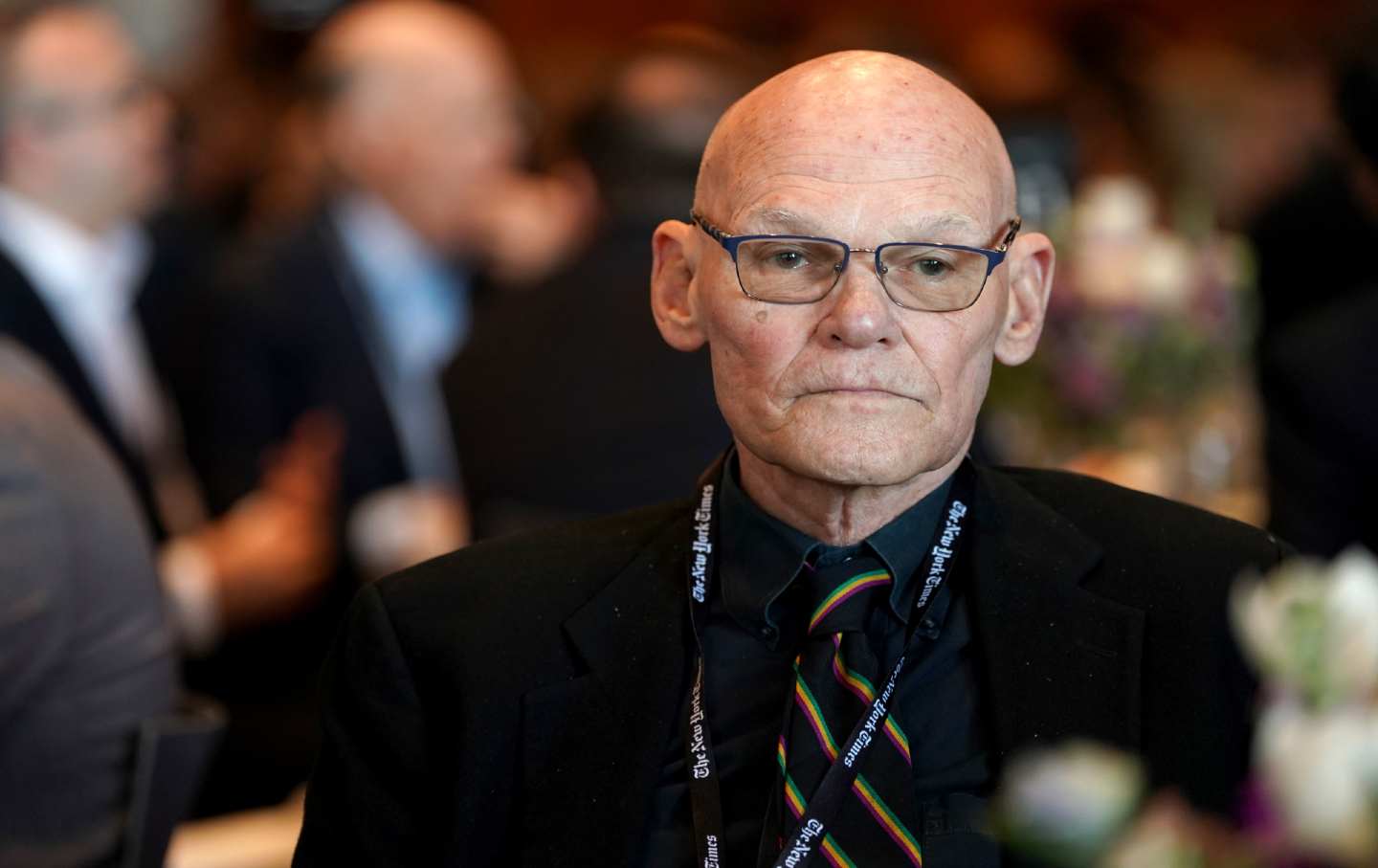
Democratic political consultant James Carville at last year’s New York Times DealBook summit.
( David Dee Delgado / Getty Images for The New York Times)
Right now there are hundreds of Democratic fundraising e-mails in my inbox, putatively from former Democratic strategist James Carville. If I wanted to avoid them entirely, I could block or unsubscribe from the various campaigns and PACs sponsoring them, but that would not prevent me from having to listen to Carville give terrible advice to Democrats. That’s because he’s also a regular on cable news, heavily quoted in newspaper and magazine articles about election prospects for the party, and an interview subject on seemingly all of America’s political podcasts.
He recently appeared with Bill Kristol on a podcast hosted by The Bulwark and stated that he’d rather Republicans keep the House by a five-member majority after the midterms than have Democrats win, because then “they’re hostage to the DSA.” The Daily Beast, long tethered to a clickbait-through-faux-outrage business model, ran an account of Carville’s comments under the sensationalistic headline “Top Dem Strategist Makes Shock Midterms Wish.” Unfortunately, though, the fact that Carville is bashing progressives and suggesting they’re worse than Republicans is not shocking at all: He’s been doing that for years now, at every opportunity.
This has put me in the uncomfortable position of trusting Carville less than Bill Kristol, one of the architects of the Iraq War and a Republican conservative turned Never Trumper. Unlike Carville, Kristol at least seems to understand what progressives stand for and occasionally concedes that they have good points. “I don’t agree with people saying ICE and CBP need ‘more training,’” Kristol wrote on Bluesky recently. “They’re doing exactly what this administration has trained them to—impose a reign of fear in blue cities. They don’t need more training. They need to be ripped up root and branch.” In the absurdist political world of 2026, in other words, we have Bill Kristol calling for ICE to be abolished, and James Carville rooting for ongoing Republican rule in Congress in lieu of having his political sensibilities unpleasantly challenged.
Carville loathes the left in a knee-jerk way that isn’t backed by any serious thoughtfulness about what progressives want—or even what voters at large want. A majority of Democrats want Medicare for All. Seventy-four percent of Democrats want to tax the rich more. Four in 10 Americans (not just Democrats!) think capitalism isn’t helping them and are open to socialist solutions to some problems. Sixty-four percent of Americans think we should give Israel less military and financial support. These are all things that Carville and his cohort of 1990s-era political power brokers like to characterize as views held by tiny, unrealistic, and leftist minorities.
Carville often distorts the positions of the Democratic Socialists in particular, intentionally reinforcing negative characterizations lofted by fellow pundits at one of his preferred outlets for bloviating, Fox News. In August he criticized a DSA candidate on the basis that he “has the attribute of every DSA member in the country, and that is he has a motor mouth.”
James Carville complaining that someone who is not James Carville has a motor mouth is like Donald Trump complaining that someone who is not Donald Trump has a reputation for bankrupting casinos. But self-awareness is not Carville’s strong suit generally. He also likes to mouth loyalty to the working classes, playing up his “ragin’ Cajun’” persona while being married to a former Republican consultant and from the comfort of one of his multiple multimillion-dollar homes.
Current Issue

Still, Carville’s greatest offense is continuing to live in the reality of Clinton-era politics while spouting advice to those of us who live here in 2026. Some of this might be chalked up to age and complacency. Carville wouldn’t be the first 81-year-old who doesn’t have his finger on the pulse of what anyone under the age of 40 is thinking or doing. He’s also not the first man to enjoy early success and dine out on it for decades—or to assume that the expertise founded on that achievement is stable over time and does not need to be refreshed or reassessed as circumstances change. He is also not the only Democrat to trot out a ’90s-era political playbook posited on the vital role played by s a nebulous center of reasonable moderates in the electorate who switch back and forth between parties. Nor is he the only aging centrist who believes, wrongly, that the far left is as dangerous as the far right.
But he is one of the people who can’t stop talking about it. And for some inexplicable reason, he’s the outraged centrist whom the media can’t stop platforming as an avatar for mainstream Democratic politics—even as he stubbornly refuses to educate himself about who progressives are and what they want, beyond crude ideological caricatures that wouldn’t be out of place in the editorial pages of The Wall Street Journal.
He’s also still leaning on the idea that elections are about one issue: the economy. I watched D.A. Pennebaker’s The War Room three years after it came out, in a political science class taught by a former Republican consultant. I don’t remember any specific lines from it except Carville’s “it’s the economy, stupid” mantra, which, more than anything, defined Carville’s brand as a strategist to the public. Like many early Carville-isms, there was truth to it, but it was also an oversimplification. Voters are always driven by economic concerns, but elections are never about one thing—even Bill Clinton’s victory over George H.W. Bush, in the midst of a deep recession, was driven by increasing disillusionment with the first Iraq War, Clinton’s personal charisma and media savviness, and a host of other things that had little to do with the real economy.
We’re in much the same position now, as voters are angry over the state of the economy, but also register strong sentiments against rampant corruption and threats to democracy. Nevertheless, Carville is relentlessly on his 1992 message, trotting out a variation of “it’s the economy, stupid” on the countless occasions he’s in front of a camera or podcast mic. In a recent Fox News appearance, he brayed that Democrats need to avoid culture-war issues and identity politics and just focus on the economy. “quit f—ing around with all this cultural stuff and start talking about people’s wages…. Start talking about what we can do to protect people who are trying to make it and particularly young people.”
By protecting young people who are trying to make it, he did not mean protecting immigrants as they seek to avoid violence and detention from ICE, young women who need abortions, or young Black men who don’t want to be killed or beaten by the police. Nor was he referring to young trans people who end up murdered because the right paints them as sexual deviants or pedophiles, and people in Carville’s cohort nod solemnly and say maybe they have a point about trans women in sports. He’s talking about wages and the ability of young people to find jobs.
All politics are identity politics on some level, but like many white straight men of a certain age, Carville doesn’t consider “white straight male” an identity. It’s simply the cultural default in his view of America. He assumes the priorities of the liberal or liberal-leaning white straight man are generally good for everybody else.
But in reality, you cannot separate culture from politics, or identity from politics. Politics is about power and its uses—and elections are about who should have it. Voter perception of the economy is heavily driven by vibes in part because the metrics of the real economy—GDP, productivity growth, even inflation—don’t necessarily reflect the situation on the ground for people. Feelings of financial security are often proxies for whether people feel safe and satisfied generally.
In other words, what constitutes a kitchen-table issue—to use the refrain favored by Carville and the centrist Democratic consultant class—depends on whose kitchen table you’re sitting at. If you’re a young woman being forced to carry a baby you don’t want and bankrupted by medical bills for complications or an unexpected C-section, your earnings potential limited because now you’re not going to college and there’s a lower ceiling on your earning potential, that’s an economic issue as well as a bodily autonomy issue.
And you cannot talk persuasively about affordability without talking about class mobility via education. That ideal is under sustained attack from Republicans who oppose DEI on the basis that they do not want women and minorities in power. Meanwhile, our political economy teems with other practical obstacles afflicting the life chances of members of less-resourced communities, from the administrative burdens of receiving public assistance (some of which, it must be said, were created by Bill Clinton’s welfare “reforms”) to the increasing cost of caring for an aging population. The country’s manifold healthcare crisis—a key driver of affordability—has been made far worse by things like caretakers’ being detained and deported and ob-gyns’ withholding care because they fear criminal prosecution for treating complications in pregnancies. It’s affordability, stupid—but not to the exclusion of the things that Carville dismisses as culture war issues. In many cases, it’s an affordability issue because of these things.
Popular
“swipe left below to view more authors”Swipe →
Much of Carville’s analysis is facile and blinkered because he does not understand that the electoral environment of 2026 is not the electoral environment of 1992. “It’s negative partisanship, stupid” may not be the pithiest slogan, but it applies much more directly to politics in the Trump era than Carville’s nostrums do. There is no persuading the GOP to make common cause with Democrats—which is why Republican candidates never attempt it or talk about it. But like many self-identified centrist Boomers, Carville spends more energy reaching across the aisle to hypothetical swing voters than he does attending to the real-world plight of core Democratic constituencies.
Progressives—including the DSA members and candidates Carville keeps insulting—overwhelmingly supported Kamala Harris in the last election, far more so than the weaker independent coalitions Carville seems to want to reach with his Fox News appearances. Progressives exhibit the highest levels of political engagement in the Democratic coalition, yet Carville keeps insisting that Democrats win elections in spite of them rather than because of them.
I won’t pretend to know whether he does this because he’s genuinely ignorant of these facts, or because he just sympathizes more with neoliberal interests and thinks that if he paints the left as fringe-y, impractical, or stupid, that voters will internalize that message and pull the core Democratic electorate rightward. If Carville keeps suggesting that any Democrat’s association with Hasan Piker—a streamer he’d never heard of before this election cycle—is a bigger problem for Democrats than the associations of congressional Republicans with assorted white supremacists, technofascist interests, and Donald Trump himself, I’ll assume that Carville actually wants a Democratic Party made up of MAGA collaborationists. Either way, he does Democrats no favors, because that’s not what voters have told us—repeatedly—they want.
When I ponder the stubborn tenacity of Carville’s pundit career, I keep thinking about a recent Wired article titled “Men Can’t Stop Faking How Much They Know About AI.” That headline is not exactly surprising to me, since I’ve had men explain AI incorrectly to me as recently as yesterday. (I’m a former tech equity analyst and cohost a financial news podcast, but I am also a girl, you understand.) But the phony claims to expertise from American men catalogued in the Wired story have strong correlations with Carville-style punditry: One Harvard study cited in the piece found that when quizzed about AI leaders, men were more likely to confidently assert that they knew who specific people were—even when the names presented to them were fictional. They were also less likely to admit that they didn’t know the answer to a question.
Carville fits the same dreary profile: He’s overconfident about what thinks he knows and will not admit to what he doesn’t. Democrats and media organizations do not need to keep giving him a megaphone. There are plenty of smart people in Democratic political circles who have worked on an actual campaign since the turn of the century, who have informed and helpful things to say, and who understand that the Trump-era GOP is not analogous to prior GOP regimes. Nor do they uncritically assume that today’s Democratic constituencies are analogous to the coalition that put Bill Clinton in office.
James Carville has plenty of money, social connections, and leisure pursuits to keep him busy—which is more than most Americans get to enjoy during their retirement years. If he really wants to help Democrats, he might put his energies there—or at the very least, step back, stop talking, and see if he might, at long last, learn how to listen.
More from The Nation

Demonstrators take to the streets in protest against an ICE shooting in New York City. Foley Square, October 2026.

The mayor is being given a series of false choices over his public-safety agenda. But there is another way forward.

It’s a familiar line in the midterms: Anti-trans attacks are a “distraction” from “kitchen-table” issues. That sends a chilling message about whose rights are worth fighting for.

In a world dominated by neoliberal market fundamentalism, “socialism” is what will make a more moderate, regulated form of capitalism work for most people.
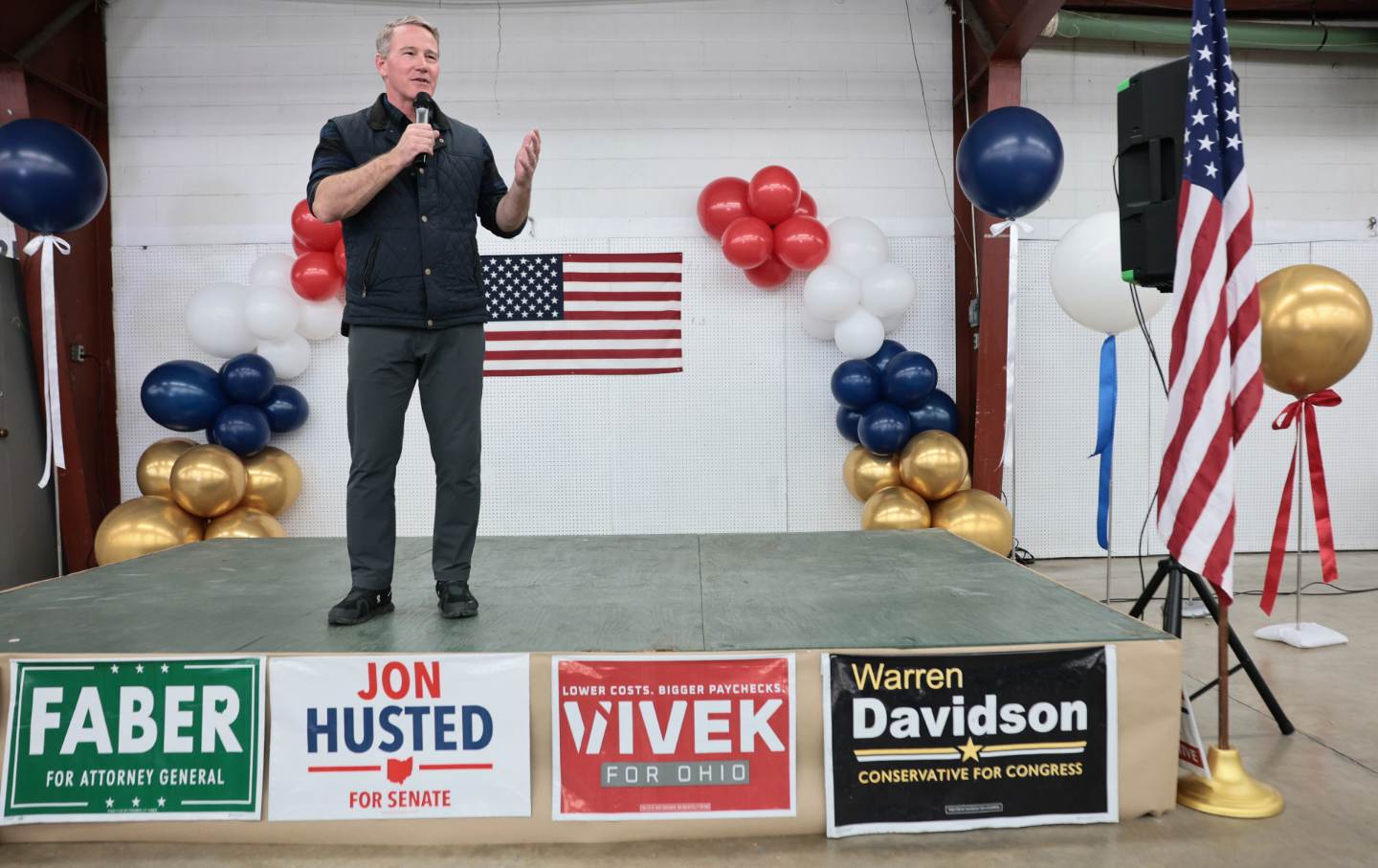
Former senator Sherrod Brown is leading in most polls, but a tidal wave of spending may prop up the struggling incumbent.
