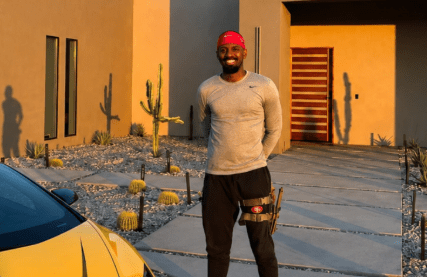
The internet spent the entire weekend locked in on the story of Daejon Love, and once you start going through the details, it’s easy to see why. Federal prosecutors say Love spent years convincing women that he was either a San Francisco 49ers player or a wealthy real estate investor, complete with 49ers gear, luxury cars, fake financial accounts and an alleged accomplice posing as his investment adviser. Authorities say at least 26 women were convinced to hand over roughly $1.3 million, with some even taking out personal loans after being promised huge investment returns. Love and alleged accomplice Taylor Jamie Chan were arrested at Boise Airport on August 24 and charged with conspiracy to commit wire fraud and wire fraud.
Then the internet started digging, and somehow the story got even wilder. Videos surfaced of Love seemingly staging his own 49ers contract signing, talking about the NFL lifestyle and showing women supposed luxury homes, cars and jewelry. The situation even helped lead social media sleuths to another man whose supposed NFL résumé didn’t add up. And while the Love case sounds almost too ridiculous to be real, he’s far from the first person whose alleged — or proven — scheme has become an internet legend.
Daejon Love
Love allegedly built one of the more elaborate fake-athlete personas we’ve seen online, telling women he played for the 49ers while also presenting himself as a successful investor. Prosecutors say he and Chan showed victims fabricated account balances and investment gains, sometimes during three-way FaceTime calls, before convincing women to transfer money or take out loans. Investigators say none of the identified victims received investment returns, and the FBI believes there could be additional victims. Love has only been charged, meaning these accusations have not yet been proven in court.
Uras Agee IV
While people were still trying to wrap their heads around the Love story, internet detectives shifted their attention to Uras Agee IV, a former Division II football player whose online presence reportedly portrayed him as an NFL veteran. Agee allegedly claimed connections to the Dallas Cowboys, Pittsburgh Steelers and Tampa Bay Buccaneers, even presenting himself as a Super Bowl LV champion despite there being no record showing that he played in the NFL. Posts and videos also reportedly showed him signing autographs, speaking to young football players and appearing in a graphic suggesting he had joined Roc Nation Sports. As of August 31, Agee has not been criminally charged in connection with those claims.
Malachi Love-Robinson
Long before fake NFL players had social media in a chokehold, Malachi Love-Robinson became nationally known as the teenager pretending to be a doctor. At just 18, “Dr. Love” opened the New Birth New Life Medical Center in Florida despite having no legitimate medical license, and authorities said he examined patients before an undercover officer helped expose him. He later pleaded guilty after stealing $30,000 from an elderly patient and another $20,000 from a doctor. And somehow that still wasn’t the end: years later, Love-Robinson was sent back to prison after pleading guilty in another fraud case involving more than $10,000 stolen from his employer.
Ramon Olorunwa Abbas — “Hushpuppi”
If social media flexing were a sport, Ramon Olorunwa Abbas, better known as Hushpuppi, built one of the loudest personas on the internet. His Instagram was once filled with designer clothes, luxury cars, private jets and expensive watches, but federal prosecutors said that lifestyle was financed through international cybercrime and money laundering. Abbas pleaded guilty to money-laundering conspiracy, with court documents tying him to business-email-compromise schemes and other fraud that caused more than $24 million in losses. He was sentenced in 2022 to 135 months in federal prison and ordered to pay more than $1.7 million in restitution.
Shimon Hayut — “The Tinder Swindler”
Most people know Shimon Hayut by the name Simon Leviev, thanks to Netflix’s viral documentary The Tinder Swindler. Hayut allegedly met women on Tinder while pretending to be the wealthy son of diamond billionaire Lev Leviev, treating them to private jets and extravagant dates before claiming his mysterious “enemies” had put him in danger. Women said he then persuaded them to take out loans or credit in their own names so he could supposedly stay financially untraceable, while money from one relationship helped bankroll the lifestyle used to impress the next victim. Hayut had previous fraud convictions and was sentenced to 15 months in prison in Israel in 2019, although the specific allegations featured in Netflix’s documentary were not what produced that sentence.
Punchmade Dev
Punchmade Dev sits in a stranger spot on this list because scamming isn’t just something people accuse him of — it became part of the entire persona surrounding his music. His 2023 song “Wire Fraud Tutorial” went viral for presenting what sounded like instructions on how to commit financial fraud, and YouTube ultimately removed its music video under its harmful or dangerous content policy. Cybersecurity journalist Brian Krebs later reported that online properties linked to Punchmade were promoting stores offering items such as accounts, financial information, and check-printing software, although Dev has disputed connections to some of the activity attributed to him. Unlike several people on this list, there isn’t a comparable federal fraud conviction proving that everything attached to his “scammer” image is real, so his reputation remains a mix of provocative music, internet persona and documented scrutiny.
Kayla Massa
Influencer Kayla Massa had hundreds of thousands of Instagram followers when prosecutors accused her of using social media to recruit people into a massive bank-fraud operation. Authorities said Massa and others posted Instagram and Snapchat advertisements promising followers “quick cash,” then obtained their banking information, deposited fraudulent checks and used debit cards to withdraw money before the banks caught on. Federal prosecutors estimated losses from the overall alleged conspiracy at more than $1.5 million, with victims often left dealing with negative balances and damaged credit. Massa was one of 10 people charged with conspiracy to commit wire fraud and bank fraud in the 2020 federal case.
Brittany Dawn Davis
Fitness influencer Brittany Dawn Davis built a huge following selling supposedly personalized nutrition and workout programs priced from roughly $92 to $300. Customers eventually started comparing notes online and alleged they had received nearly identical plans while many of the promised one-on-one check-ins and coaching sessions never happened. The Texas Attorney General sued Davis over deceptive business practices, and she eventually agreed to a $400,000 settlement, including $300,000 in civil penalties and $100,000 in restitution. Her downfall became especially viral because many of the customers who came forward said they had sought her help while struggling with eating disorders.
Billy McFarland
Few internet-era scams produced memes as legendary as Billy McFarland’s Fyre Festival. The 2017 event was marketed on Instagram as an ultra-luxury festival in the Bahamas filled with influencers, beautiful villas, gourmet food and major musical acts, only for attendees to arrive and find disaster-relief tents, unfinished infrastructure and the infamous cheese sandwiches. Prosecutors later showed that McFarland had also lied to investors about Fyre Media’s finances, using fraudulent documents to help raise millions of dollars. He pleaded guilty to federal fraud charges and was sentenced to six years in prison, turning Fyre Festival into perhaps the definitive cautionary tale about believing everything social media sells you.
Angel Murdock
Former Temptation Island contestant and influencer Angel Victoria Murdock spent nearly two years documenting what she claimed was her journey through Duke University’s prestigious Physician Assistant Program, posting everything from study sessions and clinical rotations to eventual graduation photos. The problem? Duke told multiple outlets that it has no record of Murdock ever applying to or attending the program, and actual PA students began exposing inconsistencies, including her wearing the wrong graduation regalia and never appearing in class photos or the ceremony. The digging didn’t stop there either: Murdock had also claimed to be a licensed real estate agent in North Carolina and Georgia, but reporting found no record of those licenses, while UNC Charlotte confirmed she attended the school but did not graduate as she had apparently claimed. As of now, she has not been charged with a crime over the claims, but she deactivated several of her social media accounts as the story went viral.
Whether the scheme involved pretending to play in the NFL, opening a medical office without actually being a doctor, selling fake dreams through Instagram or convincing someone they were dating the heir to a diamond fortune, the basic formula usually isn’t that different. The internet gives people an incredible amount of power to manufacture an image of wealth, success or expertise — and sometimes that image looks convincing enough for other people to put real money behind it. The Daejon Love case is simply the latest reminder that online, the gap between somebody looking rich and actually being rich can sometimes be nothing more than a rented car, a convincing Instagram page and a whole lot of audacity.