


I grew up in a neighborhood manufactured by the University of California, Irvine. It felt like a utopia for academics—until the university forsook its mission of serving the public.
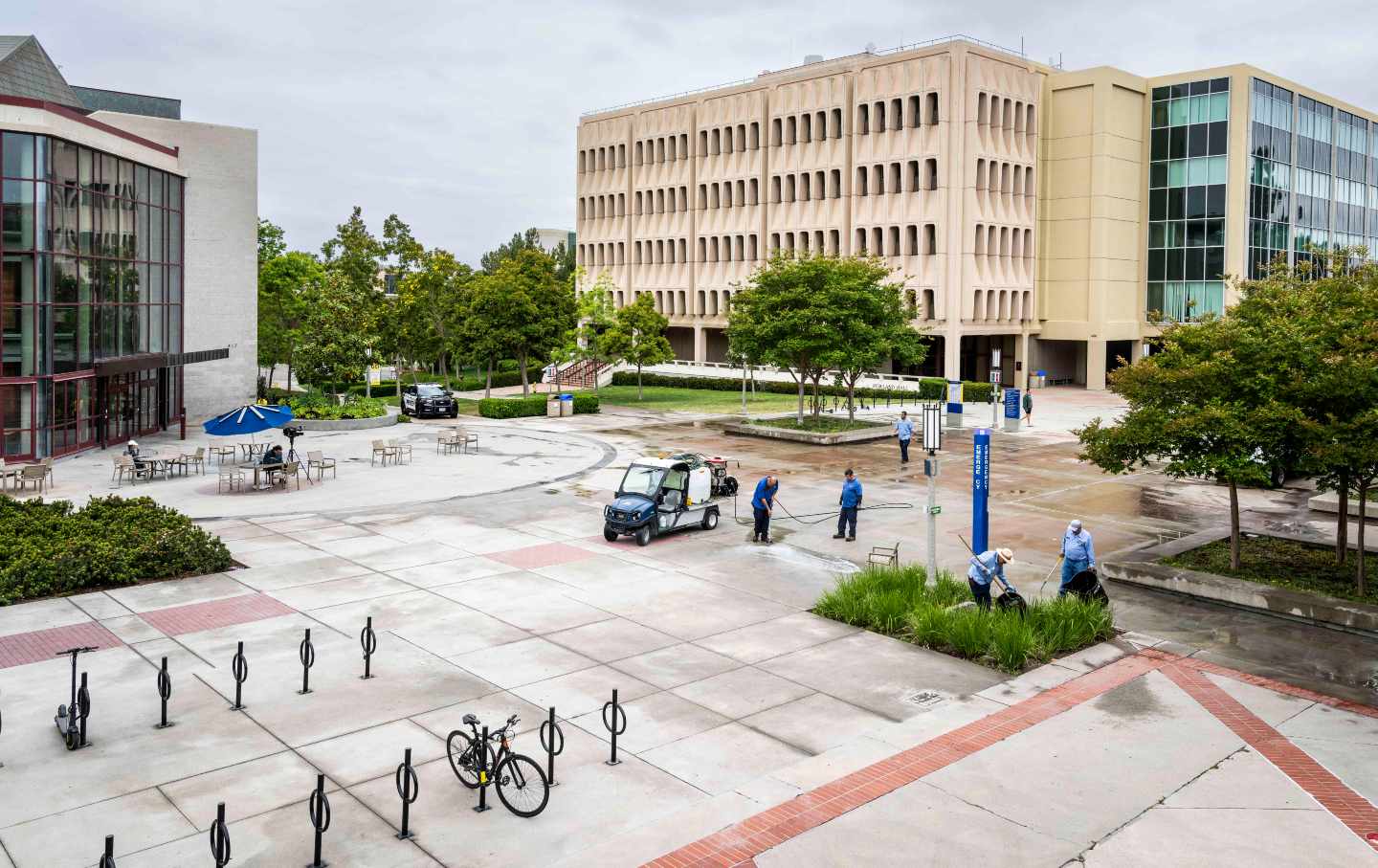
Crews clean up the area of a pro-Palestinian encampment at UC Irvine in Irvine, CA on Thursday, May 16, 2024.
(Paul Bersebach / MediaNews Group/Orange County Register via Getty Images)
My mother likes to tell a story about one of her first experiences in Irvine. Our family had just moved from a one-bedroom apartment in Manhattan—my brother and I, ages 2 and 5, had shared an alcove—to a stucco house with a brilliant green lawn and a real backyard. It was a perfect day, as most days in Southern California are: cloudless and seemingly untroubled. She ventured out for groceries with us, still unaccustomed to the luxury of doing errands by car. As the cashier packed up my mother’s purchases, he volunteered to carry them out to the parking lot for her. He didn’t realize that he was speaking to a hardened New Yorker. This condescending guy thinks I need help? my mother thought. Later, as she was herding us back to the car, laden with plastic bags, it occurred to her that maybe he really was just being friendly—that such earnest displays of generosity were to be expected in our strange new home. If we were to fit in, we would have to dispose of our East Coast wiles and learn to live like proper Southern Californians: utterly assured of our supreme luck and bounty.
We hadn’t meant to end up on this side of the country. But my father, a scientist, had been offered a tenured position at the University of California, Irvine, one of the 10 campuses that make up one of the largest and most well-known public university systems in the country. It was an offer too good to pass up: a stable gig, with plush benefits for relocators. Even then, in the late 1990s, the academic job market was beginning to look dire. Young academics were steeling themselves for careers spent scrounging for low-paid work in high-cost cities. Irvine was remarkably expensive—filled with glittering sports cars and Xanadu-like mansions—but UCI would help offset the costs of living there. New professors were granted access to affordable housing in a neighborhood set up by the university in the low-slung foothills of Orange County, and there were strong public schools nearby. My parents had never thought they’d own a real home, but suddenly they had one—with a below-market-rate mortgage subsidized by the university, at that.
Irvine, a suburb of Los Angeles, was not like New Canaan or Scarsdale: the genteel, majority-white hamlets outside of New York City that my NPR-listening, electric car–driving parents pledged they’d never move to. UCI’s 15,000-student campus was home to thousands of first-generation students, many of them the children of immigrants and refugees who had settled in Orange County after World War II. Scattered around the campus were Chinese churches, Iranian restaurants, and Korean grocery stores. With its Brutalist buildings and cavernous expressways, Irvine had none of the bucolic charm of a New England college town. But it felt remarkably modern and heterogeneous, almost uncannily so—as if parts of the “It’s A Small World” attraction from nearby Disneyland had come to life.
For the first few years, we didn’t ask questions about the deal we’d accepted: whether the university could always be counted on for its largesse, say, or whether Irvine was truly the Benetton-esque utopia it appeared to be. We were Southern Californians now, after all. We were learning to “practice gratitude,” as the locals said, and there was much to be grateful for. Irvine was a community dedicated to the pursuit of knowledge in a country that seemed stubbornly opposed to it. Every street in our neighborhood was named for a famous thinker, and when we went on walks, my parents would point them out to me: Twain Street, Zola Court. We marveled about the Nobel Prize shortlisters whom we saw collecting newspapers from their driveways in bathrobes. Our next-door neighbors included physicists, deconstructionists, and a well-regarded mathematician named Abel Klein. (I sometimes spotted his son, Ezra—you might have heard of him—trooping home from the school bus.)
We lived in handsome Spanish-style houses, most of them nearly identical to one another (and which the UCI housing authority did not permit us to paint different colors). The university even paid for landscapers to mow our lawns and trim our hedges. I wasn’t old enough to fully understand what a university was or what it did, but I was already developing a sense of loyalty to this institution for all it had given my family, and for all it seemed to represent: security, progress, the triumph of intellectualism. If there was something disquieting about this Levittown for the scholarly set, it hadn’t yet registered to me.
Irvine felt manufactured because it was: It had been planned around the university, instead of the other way around. In the early 1960s, the state acquired a tranche of land from the affluent Irvine family, whose 100,000-acre ranch, studded with citrus groves, ran from the Pacific Ocean to the inland mountains of Riverside County. The idea was to build a new campus for the rapidly expanding UC system—sometimes referred to by its wonkish, tongue-tripping sobriquet, the “multiversity.” When UCI opened in 1964, the architect tasked with its design, William Pereira, was hard at work on a “city of intellect,” as he called it, to complement the new campus. In later years, Irvine would become one of the wealthiest suburbs in the country, and thanks to its architect’s master-planning, an astonishingly pristine, orderly city—devoid of the urban sprawl that Pereira, a former Hollywood art director, found unsightly. None of this would have been possible without the state’s investment in higher education for the masses.
Current Issue

Almost exactly 100 years before Irvine was constructed, a group of New England Congregationalists who had settled in Northern California during the Gold Rush founded the college that later became known as UC Berkeley. As the journalist and historian Miriam Pawel writes in her sprawling history of the UC system, California Dreams: The Making and Remaking of the University of California, most of Berkeley’s founders were Yale graduates, but they considered themselves converts to the rugged manifest-destiny lifestyle. They weren’t interested in replicating the clubbiness of the Ivy League out West, but in seizing on a pioneer ethos of reinvention. In 1868, they volunteered their fledgling school to become California’s designated land-grant university under the Morrill Act, which provided federal funding for new state colleges that would serve the nation’s growing working class. (The secession of the Southern states had provided a window of opportunity to force through such patently progressive legislation.)
These early leaders made their aims clear: to mold an educated elite in the state of California. Berkeley would not be a vocational school, or focus solely on agriculture and mining, as other land-grant colleges had. Rather, it would provide Californians with the kind of comprehensive liberal arts education that tended to produce scholars and politicians—but entirely free of charge. It would admit those who distinguished themselves intellectually, regardless of whether their families were in the right Episcopalian congregation or had their name emblazoned on a library.
At California’s constitutional convention in 1879, a delegate advocating for Berkeley declared that “the son of the poorest peasant, no matter how lowly” would find the university “an institution to carry him to the furthest realms of knowledge.” Race was not an explicit part of the equation—the founders had mostly poor white “peasants” in mind—and women, though not altogether siloed from men, were still patronized on campus as “bluestockings.” Yet, as Pawel explains, the university was attempting something without real precedent: to offer a pathway to upward mobility that was also “a counterweight to the landed ruling class that was fast emerging” in the nation’s new industrial economy. It was, in short, a wholly meritocratic project, with more than a whiff of frontier optimism.
As it happens, Berkeley’s founders had cause to be bullish about their ambitions for public education. California came roaring into the 20th century to become one of the most populous states in the union, and the university tripled its enrollment from 1899 to 1919, drawing extensively from a new working-class population. Offshoot campuses were opened to complement Berkeley and accommodate students further afield: an agricultural school in Davis, west of Sacramento, and a branch in Los Angeles. During World War II, the defense industry found a foothold in Southern California, which would become a staging ground for operations in the Pacific Theater, and the state’s labor force nearly doubled. By the late 1950s, a loose agglomeration of affiliated schools had been reorganized into a functioning university system. UC administrators began drawing up plans for a southern expansion of the multiversity, which already encompassed tens of thousands of students—none of whom needed to pay tuition.
Irvine was the sixth addition to the system, after early successes in Santa Barbara and Riverside. As the only member of the UC system to be constructed completely from scratch, UCI had no preexisting infrastructure to overhaul, and no pesky townspeople to cater to, which made it an ideal testing ground for its administrators’ goals. The “instant university,” as it came to be called, was intended to usher California into an age of innovation and prosperity.
Orange County was an unlikely place for such an initiative. It was a stronghold of libertarian-inflected conservatism, strewn with John Birchers and ranchers-turned-developers who wanted the government off their land. Many of UCI’s founders—though technically government men themselves—were straitlaced Republicans who sympathized with those views. But the university they devised would send today’s woke-fearing conservatives into conniptions. As Pawel notes, it emphasized burgeoning fields such as computer science and critical theory; UCI was the first American university to offer a doctorate in the latter subject, famously hiring the French theorist Jacques Derrida. There were outdoor colloquies that bore a resemblance to consciousness-raising sessions. UCI’s School of Fine Arts housed a rigorous visual art program: According to Pawel, one ceramics professor “would line up students’ works and smash them with a baseball bat if he thought they lacked artistic value.” The university’s first chancellor, Daniel Aldrich, was a registered Republican, a church-going teetotaler, and an avid defender of free speech who bucked criticism and encouraged students to invite speakers who’d been deemed controversial to the campus, including the Black Panther leader Eldridge Cleaver and the SDS activist Tom Hayden.
Just as Berkeley and the other campuses had before it, UCI pursued what one administrator called an “egalitarian-meritocratic” mission, aggressively recruiting low-income students—many of whom were happy to trudge to class on dusty, unpaved roads while the master-planned city was still coming up around them. New faculty were lured away from positions at more established or older universities by promises of academic autonomy and faculty housing, as my father would be years later. Some people in surrounding communities fretted that this quirky, newfangled campus would lead to an insurgence of “foreigners, Jews and communists,” Pawel notes. But as UCI spurred rapid economic growth, attracting new industries—and plenty of foreigners, though fewer Jews and communists, eager to study at the university—those anxieties dwindled. In Irvine, it seemed, the progressive ideals of the UC system had overcome the puerile plaints of homegrown conservatism. The instant university had proved that free, accessible public education could be a boon for everyone, town and gown alike. But a backlash was brewing—one that would bring an end to this brief era of experimentation and permanently destabilize the universities.
The trouble began three years after UCI welcomed its first class of students, in 1967. A middling Hollywood export named Ronald Reagan had just been elected governor, and he set about refashioning the state’s priorities. Reagan had campaigned on a promise to root out “Communist influence and sexual misconduct” at Berkeley, then the site of student protests over the Vietnam War. His larger mission was to shrink the government and slash public funding, starting with the multiversity, which he portrayed as bloated and venal, the province of a priggish liberal elite. Once in office, he swiftly organized the Board of Regents—the governing body of the UC system, composed mostly of political appointees—against UC president Clark Kerr. Kerr argued that free access to quality education had helped produce California’s highly skilled—and remunerative—workforce. But Reagan saw an opportunity to wrest control of the universities away from socially minded administrators like Kerr and enact austerity measures that would further a revanchist Republican agenda: lower taxes, lower public spending. The speed with which he moved to curtail public education shocked even some of his proponents, who were broadly supportive of the universities. The Los Angeles Times, which had endorsed him in 1966, called his decision to target the UC system “inept.”
In exchange for Kerr’s ouster and an end to free tuition, Reagan agreed to drop an investigation into charges of anti-American radicalism on UC campuses (the same playbook the Trump administration has lately used to extort universities across the country, including the UC system). In the coming years, state funding would be rolled back, and students—tens of thousands of them from lower-income families—would be forced to pay their way, striking a blow to Berkeley’s founding ideals and forever altering the universities’ demographics. Fewer Californians would be admitted as the UC system made room for out-of-staters, who would be subject to higher fees. The already struggling junior colleges in the state would be burdened with more enrollees as less affluent students were shunted into them. Ultimately, the multiversity would be hard-pressed to function as an “engine of social mobility,” in Pawel’s words; its schools would begin to resemble the restrictive private institutions they were supposed to distinguish themselves from. “We’d like to welcome the academic community into the cold world of reality,” Reagan crowed at a meeting of the regents in January 1967.
By wielding the Board of Regents as a political tool, Reagan put more responsibility into the hands of UC leaders with a markedly different vision for the universities, who would set their sights on any initiative that reeked of liberal do-goodism. Affirmative action policies had been imposed in the late 1960s to address an original weakness of the UC system—its inattention to racial diversity—and they had succeeded in enrolling more Black and Latino students. In the 1990s, Republican-allied regents worked to undo them, and even helped advocate for a ballot measure to ban affirmative action across all public institutions in the state, which passed two years before my family arrived in California. Minority enrollment at the universities promptly plummeted.
The regents also continued ratcheting up tuition. By 2010, fees for in-state students had ballooned to $10,000 annually, up 32 percent from the previous academic year. I was 14 then, and like many children at the time, I had been vaguely aware of the 2008 financial crisis: the darkening of the collective mood, the panicked whispering among adults when they thought their kids were out of earshot. Its aftershocks could be felt across the country, and other state universities had raised tuition to offset deficits—but none as steeply as the UC system.
Most of the regents in office then had been appointed by Reagan’s spiritual successor, Arnold Schwarzenegger, and they blamed the increase on the state budget crisis he had inherited as governor. But the regents had also been responsible for shifting billions of dollars in endowment funds into risky private equity investments—some tied to their personal business interests—that had generated enormous losses during the Great Recession. And while the regents’ salaries remained in the high six figures, faculty and staff across the state were being laid off or furloughed en masse. My father, who conducted cancer research—a field deemed more useful than others—was spared, but some of our neighbors were not so lucky. I splashed around with these professors’ children at the neighborhood pool while they murmured to each other about things I had never known people in Irvine to fret about: mortgage payments, unpaid bills, the possibility of moving away.
Meanwhile, students were launching protests at every UC, including Irvine. I now remember them in a blurry, half-formed way: hundreds of students marching through the verdant park near the central quad, chanting messages whose import I was only beginning to grasp. There were sun-baked sit-ins and neatly drawn signs: Defend UC Irvine: Education = Public Good. Commentators noted, with some amazement, that the Irvine demonstrations were led mainly by first-generation students of color, many of whom would struggle to afford the higher tuition costs—locking them out of the meritocratic system they’d been sold on. Their grievances also addressed Irvine’s own deficiencies. New initiatives were needed to compensate for the loss of affirmative action, but administrators had been too slow to respond: Hispanic students now made up less than 20 percent of the undergraduate student body, even though Orange County was more than 30 percent Hispanic. They had also yanked funding for the experimental programs UCI’s founders had championed, claiming that the Regents had tied their hands. Students noted to reporters that Irvine’s leaders seemed far less invested in defending the university than their predecessors had been. In 1967, then-chancellor Daniel Aldrich stood outside his office and protested the end of free tuition alongside 5,000 students, some of them hoisting Reagan effigies. Now UCI leaders were suspending protesters and letting police arrest them; they shrugged off students’ concerns and suggested that they go bother the regents in Sacramento instead.
Even if I didn’t fully understand the meaning of these protests, I remember feeling struck by the students milling around the campus that year: how adult they seemed, how undaunted. I could see that for them, learning was not just about the rote accumulation of facts—one had to question those facts, too, and consider the forces that had brought them into existence. I had taken for granted that life in Irvine would always be stable, that education would always be accorded the highest value, and that the university was righteous and beneficent. I had no vocabulary for the mechanisms of power and profit whirring away beneath this tidy, tranquil world, but now I was dimly aware of them. And I had questions of my own: Would my friends’ parents get their jobs back? Would my father’s students be able to continue their studies? And what would happen to other, more precarious people around us—like the Hispanic men who trimmed our bushes every day? My parents told me that they were day laborers, possibly undocumented, and almost certainly paid under the table by the university, which meant that they had no healthcare and no job security. That made them cheap enough to retain. Thanks to their labor, the lawn I walked across every day to go to school would remain clipped to perfection.
Not long after, when I was in high school, my family finally left Irvine. By then, some of the unrest had caught up to us. My father’s department was struggling, and conditions seemed unlikely to improve. We’d seen enough families depart the neighborhood by then to recognize the signs: the slimmed-down budgets, the overloaded teaching schedules. Even tenured professors could be creatively pressured to leave, especially in times of turmoil. We packed up the stucco house, bid farewell to the endless 75-degree days, and shuttled ourselves back to the East Coast, this time landing in the bleak, deindustrialized reaches of upstate New York—where at least appearances seemed to reflect reality, and people did not expect very much from the institutions with which their lives were entangled.
In California Dreams, Pawel is careful to describe the convulsions the UC system suffered throughout the 20th century. But she concludes the book on a sanguine note; she seems to have absorbed some Southern California optimism herself. The University of California, she insists, has “remained one of the few forces that transcended disparate regions and groups” in the nation’s most multifarious state. It still enrolls hundreds of thousands of students each year, some of them the first in their families to go to college; Irvine, she points out, now leads in applications from first-generation students. Its faculty members conduct ground-breaking research, supported in some cases by generous perks, like those my family benefited from. (Adjuncts and postdocs, notably, are largely excluded from them.) Its universities are more affordable than other comparable, elite institutions. No campus has had to close, as some have feared would happen during moments of acute uncertainty.
Popular
“swipe left below to view more authors”Swipe →
All of this is true, and yet it’s difficult to look back on the past 50-odd years of the UC system without noticing what has been lost, and how much has changed. The history of these schools is also the history of so many American experiments that withered as the country lurched rightward and grew more fractious—the way New Deal reforms and environmental protections, say, have been undermined by generations of hard-liners and their accommodationist collaborators. The multiversity was hardly a revolutionary project, premised as it was on a gauzy vision of elite ascendancy. Yet, for a period of time, it made California an outlier—helping to narrow the educational gap that has long been an assumed feature of American life.
Now, unfortunately, that gap is widening again, and the schools are taking steps backward. The UC system has come to rely more and more on private funding and out-of-state tuition fees to operate. Its universities often function more like extractive corporations, with their attendant abuses of labor and entrenched hierarchies, than institutions of public good. Tuition continues to climb as faculty salaries stagnate, and positions in departments deemed frivolous—those involving outmoded pursuits like writing or critical thinking—are routinely shorn away. Funding battles have persisted, even as California has become a solidly blue state. Administrators are locked in squabbles over how to address admissions standards—much has been made of recent findings that some freshmen cannot do algebra—as well as disparities within the system. Some of the campuses have become prohibitively selective and less socioeconomically diverse, while lower-income students are sorted into the less prestigious, under-resourced schools. Meanwhile, politicians in the Reagan mold bark about liberal excess and seek to hamstring the system with brazenly illegal schemes.
These issues are present but not outwardly visible in Irvine, which remains surpassingly wealthy and serene. It is the eighth-happiest city in America, according to a recent study by WalletHub.
These days, when I go back to visit the place where I spent my formative years, Irvine strikes me as discomfitingly sterile. It’s hard to imagine anything subversive happening in its sea of strip malls and subdivisions. But positive signs of life are discernible. There are the corners of campus, under thickly wooded trees, where students still gather to protest budget cuts and administrative recalcitrance. There are new streets in my old neighborhood, these ones now named for Maya Angelou and Sojourner Truth. The university hums with activity by day and grows thoughtful by night. On these visits, I find myself experiencing a new strain of an old, familiar feeling: gratitude. Not for the faceless university, but for the people who cared about it—and those who still do, on whom its future depends.
Between the reemergence of right-wing red-baiting and Donald Trump’s use of the chilling National Security Presidential Memorandum–7 to criminalize left political organizing, we’re seeing McCarthyism reborn before our eyes.
This assault on democracy cannot be ignored or wished away. Resisting it requires bravery in the face of threats and repression, a steadfast commitment to the truth, and the unwavering belief that we can—and will—overcome this darkness.
We must have an independent media that sets the record straight, unearths corruption and abuses of power, and advances a politics of justice and dignity for all if we’re to win this fight.
That’s why I’m writing to you today. This September, The Nation needs to add 100 monthly donors to sustain our progressive journalism. Your contribution makes the next investigative report, the next truth-speaking column, and the next pathbreaking essay all possible.
I hope you’ll support our work with a recurring donation today. If you donate $10 or more a month, we’ll send you a brand new “Hands Off the Free Press!” sticker to recognise your commitment to our cause. Please, donate today.
Onward,
Katrina vanden Heuvel
Editor and Publisher, The Nation
More from The Nation

Disillusioned with the nuclear family and apprehensive of tethering their reproductive futures to the bleak hellscape of modern love, young people are seeking a different way.
I serve as editor in chief and president of The Stanford Daily. Our newsroom has keenly felt the effects of Trump’s campus crackdown, which is why we sued the federal government.
Music streaming platforms have way too much control over musicians and music lovers. It’s time to rein them in.
President Trump has decried the techbro creed for indulging in AI doomerism, but its excesses are far worse than that.
According to multiple GI rights organizations, service members are inquiring in unprecedented numbers about seeking conscientious objector status.
